Socrates

"The only true wisdom is in knowing you know nothing." 

Socrates

"To find yourself, think for yourself."

Nelson Mandela

"Education is the most powerful weapon which you can use to change the world."

Jim Rohn

"Success is nothing more than a few simple disciplines, practiced every day." 

Buddha

"The mind is everything. What you think, you become." 

Friday, 30 March 2012

The 'Grammar' of Television and Film


Television and film use certain common conventions often referred to as the 'grammar' of these audiovisual media. This list includes some of the most important conventions for conveying meaning through particular camera and editing techniques (as well as some of the specialized vocabulary of film production).
Conventions aren't rules: expert practitioners break them for deliberate effect, which is one of the rare occasions that we become aware of what the convention is.
Long shot (LS). Shot which shows all or most of a fairly large subject (for example, a person) and usually much of the surroundings. Extreme Long Shot (ELS) - see establishing shot: In this type of shot the camera is at its furthest distance from the subject, emphasising the background. Medium Long Shot (MLS): In the case of a standing actor, the lower frame line cuts off his feet and ankles. Some documentaries with social themes favour keeping people in the longer shots, keeping social circumstances rather than the individual as the focus of attention.
Establishing shot. Opening shot or sequence, frequently an exterior 'General View' as an Extreme Long Shot (ELS). Used to set the scene.
Medium shots. Medium Shot or Mid-Shot (MS). In such a shot the subject or actor and its setting occupy roughly equal areas in the frame. In the case of the standing actor, the lower frame passes through the waist. There is space for hand gestures to be seen. Medium Close Shot (MCS): The setting can still be seen. The lower frame line passes through the chest of the actor. Medium shots are frequently used for the tight presentation of two actors (the two shot), or with dexterity three (the three shot).
Close-up (CU). A picture which shows a fairly small part of the scene, such as a character's face, in great detail so that it fills the screen. It abstracts the subject from a context. MCU (Medium Close-Up): head and shoulders. BCU (Big Close-Up): forehead to chin. Close-ups focus attention on a person's feelings or reactions, and are sometimes used in interviews to show people in a state of emotional excitement, grief or joy. In interviews, the use of BCUs may emphasise the interviewee's tension and suggest lying or guilt. BCUs are rarely used for important public figures; MCUs are preferred, the camera providing a sense of distance. Note that in western cultures the space within about 24 inches (60 cm) is generally felt to be private space, and BCUs may be invasive. 

Angle  of shot. The direction and height from which the camera takes the scene. The convention is that in 'factual' programmes subjects should be shot from eye-level only. In a high angle the camera looks down at a character, making the viewer feel more powerful than him or her, or suggesting an air of detachment. A low angle shot places camera below the character, exaggerating his or her importance. An overhead shot is one made from a position directly above the action. 

View point. The apparent distance and angle from which the camera views and records the subject. Not to be confused with point-of-view shots or subjective camera shots. 

Point-of-view shot (POV). A shot made from a camera position close to the line of sight of a performer who is to be watching the action shown in the point-of-view shot.

Two -shot. A shot of two people together. 

Selective  focus. Rendering only part of the action field in sharp focus through the use of a shallow depth of field. A shift of focus from foreground to background or vice versa is called rack focus. 

Soft  focus. An effect in which the sharpness of an image, or part of it, is reduced by the use of an optical device. 

Wide- angle shot. A shot of a broad field of action taken with a wide-angle lens. 

Tilted  shot. When the camera is tilted on its axis so that normally vertical lines appear slanted to the left or right, ordinary expectations are frustrated. Such shots are often used in mystery and suspense films to create a sense of unease in the viewer. 

 Camera Techniques:Movements

Zoom. In zooming in the camera does not move; the lens is focussed down from a long-shot to a close-up whilst the picture is still being shown. The subject is magnified, and attention is concentrated on details previously invisible as the shot tightens (contrast tracking). It may be used to surprise the viewer.
Zooming out reveals more of the scene (perhaps where a character is, or to whom he or she is speaking) as the shot widens.
Zooming in rapidly brings not only the subject but also the background hurtling towards the viewer, which can be disconcerting. Zooming in and then out creates an ugly 'yo-yo' effect. 

Following  pan. The camera swivels in the same base position to follow a moving subject. A space is left in front of the subject: the pan 'leads' rather than 'trails'. A pan usually begins and ends with a few seconds of still picture to give greater impact. The speed of a pan across a subject creates a particular mood as well as establishing the viewer's relationship with the subject. 

Surveying pan. The camera slowly searches the scene: may build to a climax or anticlimax. 

Tilt. A vertical movement of the camera - up or down- while the camera mounting stays fixed. 

Crab. The camera moves (crabs) right or left. 

Tracking (dollying). Tracking involves the camera itself being moved smoothly towards or away from the subject (contrast with zooming). Tracking in draws the viewer into a closer, more intense relationship with the subject; moving away tends to create emotional distance. Tracking back tends to divert attention to the edges of the screen. The speed of tracking may affect the viewer's mood. Rapid tracking  is exciting; tracking back relaxes interest. In a dramatic narrative we may sometimes be drawn forward towards a subject against our will. Camera movement parallel to a moving subject permits speed without drawing attention to the camera itself. 

Hand-held camera.  A hand-held camera can produce a jerky, bouncy, unsteady image which may create a sense of immediacy or chaos. Its use is a form of subjective treatment. 

Process shot. A shot made of action in front of a rear projection screen having on it still or moving images as a background.

Narrative style of Television Programme.


Subjective treatment.
  The camera treatment is called 'subjective' when the viewer is treated as a participant  e.g. when the camera is addressed directly or when it imitates the viewpoint or movement of a character. We may be shown not only what a character sees, but how he or she sees it. A temporary 'first-person' use of camera as the character can be effective in conveying unusual states of mind or powerful experiences, such as dreaming, remembering, or moving very fast. If overused, it can draw too much attention to the camera. Moving the camera (or zooming) is a subjective camera effect, especially if the movement is not gradual or smooth. 

Objective treatment. 
The 'objective point of view' involves treating the viewer as an observer. A major example is the 'privileged point of view' which involves watching from omniscient vantage points. By Keeping the camera even as the subject moves towards or away from it is an objective camera effect. 


Talk to camera. The sight of a person looking ('full face') and talking directly at the camera establishes their authority or 'expert' status with the audience. Only certain people are normally allowed to do this, such as announcers, presenters, newsreaders, weather forecasters, interviewers, anchor-persons, and, on special occasions (e.g. ministerial broadcasts), key public figures. The words of 'ordinary' people are normally mediated by an interviewer. In a play or film talking to camera clearly breaks out of naturalistic conventions (the speaker may seem like an obtrusive narrator). A short sequence of this kind in a 'factual' programme is called a 'piece to camera'.

Parallel development/parallel editing/cross-cutting. An intercut sequence of shots in which the camera shifts back and forth between one scene and another. Two distinct but related events seem to be happening at approximately the same time. A chase is a good example. Each scene serves as a cutaway for the other. Adds tension and excitement to dramatic action. 

'Invisible editing'. This is the omniscient style of the realist feature films developed in Hollywood. The vast majority of narrative films are now edited in this way. The cuts are intended to be unobtrusive except for special dramatic shots. It supports rather than dominates the narrative: the story and the behaviour of its characters are the centre of attention. The technique gives the impression that the edits are always required are motivated by the events in the 'reality' that the camera is recording rather than the result of a desire to tell a story in a particular way. The 'seamlessness' convinces us of its 'realism', but its devices include: 

  •  the use of matched cuts (rather than jump cuts);
  • motivated cuts;
  • changes of shot through camera movement;
  •  long takes;
  • the use of the sound bridge;
  • parallel development.
The editing isn't really 'invisible', but the conventions have become so familiar to visual literates that they no longer consciously notice them.


Montage/montage editing. In its broadest meaning, the process of cutting up film and editing it into the screened sequence. However, it may also be used to mean intellectual montage - the justaposition of short shots to represent action or ideas - or (especially in Hollywood), simply cutting between shots to condense a series of events. Intellectual montage is used to consciously convey subjective messages through the juxtaposition of shots which are related in composition or movement, through repetition of images, through cutting rhythm, detail or metaphor. Montage editing, unlike invisible editing, uses conspicuous techniques which may include: use of close- ups, relatively frequent cuts, dissolves, superimposition, fades and jump cuts. Such editing should suggest a particular meaning. 


Narration of Television story-Covering a programme

                                Every item that is broadcast must be thoroughly  researched and investigated primarily made a synopsis, it include shooting scripts, the time schedule, appointments with various persons in the city or outstation . Also the footage provided by the reporters on the spot is the main ingredient  of the report. It has to be trimmed or edited  for length weeding out repetitions or irrelevant material, and then matched with the spoken word.  Inside the studio, a variety of special effects is available, and could be used for great effect in the presentations of the news capsules. These are slow motion, freeze, frames speedup, rotating and burst. Each one has a specific function in the narration and presentations if the story.  

It is up to the anchorman to choose what  he wants for maximum  effects .  The anchor man has to be aware of the kind of impact each  shot will make on the viewer,  and  never give in to  the temptation of over emphasizing  an item or a story.    Everything that is broadcast has to be edited exalt  the fire, flood, accidents house collapse or building crash.
      
  A good editor would talked honest care to ensure that few cuts he executed do not leave jerks and disorients the viewers from the main story.  The editor uses a cut away shot to maintain continuity in the narration and the flow of the story. The cut away shots were shots before or after the main incidents. Thus cut away are the most important shots in television news .

Tone. The mood or atmosphere of a programme (e.g. ironic, comic, nostalgic, romantic). 
   
Formats and other features

Shot. A single run of the camera or the piece of film resulting from such a run.
Scene. A dramatic unit composed of a single or several shots. A scene usually takes place in a continuous time period, in the same setting, and involves the same characters.
Sequence. A dramatic unit composed of several scenes, all linked together by their emotional and narrative momentum.

Editing Techniques-Television Production

SHOT - A continuous, non-stop running of the camera.


Editing the video tape is done electronically or digitally. It is digital camera has been used for shooting or if the video scope shots have been transferred to a hards disc the editing will be done digitally.
Editing Techniques: The best way to learn editing is to have the experience of editing quality footage.  The best way to learn how to shoot video is to edit bad footage.   The process should be repeated on simple projects so the student masters both talents.
There is a language to film or video just as there is to spoken or written languages. The human mind demands that shots be presented in a logical sequence. However, the human mind of the viewer does not analyze the sequence for time. 

JUMP CUTS:Jump cuts result when two sequential shots do not make logical sense. For example, one shot shows a person standing and the next shot show the same person seated or in a different location. Except on MTV, you will never see a jump cut in a commercial film or video except for some unique artistic effect. When the mind tries to make sense of a jump cut, the viewers' train of thought is disrupted and the illusion of reality is destroyed. 
          Jump cut.  Rapid switch  from one scene to another which may be used deliberately to make a dramatic point.  Sometimes boldly used to begin or end action.  Alternatively, it may be result of poor pictorial continuity, perhaps from deleting a section. 
Eliminating Jump Cuts :The goal of any editor is to produce a video without any jump cuts. To achieve this goal, the videographer must have shot footage that provides the editor with a series of shots he can work with. The best technique to learn how to shoot for postproduction is to learn how to edit in the camera. Once you master this skill, there is little need for low budget postproduction. Several cinematic techniques are used in all films to make the material flow logically and to solve the jump cut problem. 

Cutaway Shots: Separate two shots with a shot of something completely different. During a church wedding service, a person is walking down the isle. If the camera is stopped when they are partway down the isle and then restarted as they reach the front, the result will be a jump cut. Solve the jump cut by taking a cutaway shot of a stained glass window, people in the pews, flowers or other decoration.   The mind assumes that the person moved the whole way down the isle while the viewer was watching the other shot.


Reaction Shots :Similar to the cutaway shot but contains a subject that relates to the sequence of shots. In the above example, a shot of people watching the person walking down the isle would be a reaction shot.

Walk In/Out Transitions :The jump cuts result when the same subject is in different positions in two adjoining shots. Avoided the jump cut by allowing the subject to walk out of the first shot. Then they can appear in the next shot in a slightly different place. If the space or time separating the two shots is larger, start the camera before the subject enters the shot to allow them to walk in to the field of view.

Cut-on-Action :The ultimate transition is to have matching shots where the action is continuous between two shots. Cut the shot at a point in the action and begin the next shot on the same action. Then the movement will appear to flow across the transition. Accomplish the cut-on-action by having the person repeat the action for the two shots. A close up shot of the person entering a door followed by a wide shot taken from the rear of the room. If the subject is performing a repetitive action, you can take a close up of one cycle of the action followed by a wide shot from a different angle. A person shooting baskets, diving into a pool, hammering a nail or even eating dinner are candidates for cut-on-actions.

Dissolve :The editor's mantra is "If you can't solve it, dissolve it!" The dissolve allows a transition between two shots that involves extremes in time and place. For example, a shot of Lincoln leaving Springfield would dissolve into a shot of his arrival at the capital in Washington. Unfortunately, it takes three VCRs and an edit-controller or a computer editing system to achieve this effect.


Cut. Sudden change of shot from  one viewpoint or location to another. On television cuts occur on average about every 7 or 8 seconds. Cutting may:
    • change the scene; compress time; vary the point of view; or
    • build up an image or idea.
There is always a reason for a cut, and you should ask yourself what the reason is. Less sudden transitions are achieved with the fade, dissolve, and wipe

Matched cut. In a 'matched cut' a familiar relationship between the shots may make the change seem smooth:
    • continuity of direction;completed action;a similar centre of attention in the frame; a one-step change of shot size (e.g. long to medium);
    • a change of angle (conventionally at least 30 degrees).
*The cut is usually made on an action .for example, a person begins to turn towards a door in one shot; the next shot, taken from the doorway, catches him completing the turn. Because the viewer's eye is absorbed by the action he is unlikely to notice the movement of the cut itself.

Motivated cut.  Cut made just at the point where what has occurred makes the viewer immediately want to see something which is not currently. A typical feature is the shot/reverse shot technique (cuts coinciding with changes of speaker). Editing and camera work appear to be determined by the action. It is intimately associated with the 'privileged point of view'.

Cutting rate. Frequent cuts may be used as deliberate interruptions to shock, surprise or emphasize.

Cutting rhythm. A cutting rhythm may be progressively shortened to increase tension. Cutting rhythm may create an exciting, lyrical or staccato effect in the viewer.

Cross-cut. A cut from one line of action to another. Also applied as an adjectuve to sequences which use such cuts.

Cutaway/cutaway shot (CA). A bridging, intercut shot between two shots of the same subject. It represents a secondary activity occurring at the same time as the main action. It may be preceded by a definite look or glance out of frame by a participant, or it may show something of which those in the preceding shot are unaware. (See narrative style: parallel development) It may be used to avoid the technical ugliness of a 'jump cut' where there would be uncomfortable jumps in time, place or viewpoint. It is often used to shortcut the passing of time.

Reaction shot. Any shot, usually a cutaway, in which a participant reacts to action which has just occurred.

Insert/insert shot. A bridging close-up shot inserted into the larger context, offering an essential detail of the scene (or a reshooting of the action with a different shot size or angle.)
Fade, dissolve (mix). Both fades and dissolves are gradual transitions between shots. In a fade the picture gradually appears from (fades in) or disappears to (fades out) a blank screen. A slow fade-in is a quiet introduction to a scene; a slow fade-out is a peaceful ending. Time lapses are often suggested by a slow fade-out and fade-in. A dissolve (or mix) involves fading out one picture while fading up another on top of it. The impression is of an image merging into and then becoming another. A slow mix usually suggests differences in time and place. Defocus or ripple dissolves are sometimes used to indicate flashbacks in time.

Superimpositions. Two of more images placed directly over each other (e.g. and eye and a camera lens to create a visual metaphor).

Wipe. An optical effect marking a transition between two shots. It appears to supplant an image by wiping it off the screen (as a line or in some complex pattern, such as by appearing to turn a page). The wipe is a technique which draws attention to itself and acts as a clear marker of change.

Inset. An inset is a special visual effect whereby a reduced shot is superimposed on the main shot. Often used to reveal a close-up detail of the main shot.

Split screen. The division of the screen into parts which can show the viewer several images at the same time (sometimes the same action from slightly different perspectives, sometimes similar actions at different times). This can convey the excitement and frenzy of certain activities, but it can also overload the viewer.

Stock shot. Footage already available and used for another purpose than the one for which it was originally filmed.
Invisible editing: See narrative style: continuity editing.

Manipulating Time

Screen time: a period of time represented by events within a film (e.g. a day, a week).

Subjective time. The time experienced or felt by a character in a film, as revealed through camera movement and editing. (e.g. when a frightened person's flight from danger is prolonged).
Compressed  time. The compression of time between sequences or scenes, and within scenes. This is the most frequent manipulation of time in films: it is achieved with cuts or dissolves. In a dramatic narrative, if climbing a staircase is not a significant part of the plot, a shot of a character starting up the stairs may then cut to him entering a room. The logic of the situation and our past experience of medium tells us that the room is somewhere at the top of the stairs. Long journeys can be compressed into seconds. Time may also be compressed between cutaways in parallel editing. More subtle compression can occur after reaction shots or close-ups have intervened. The use of dissolves was once a cue for the passage of a relatively long period of time.
Long take. A single shot  (or take, or run of the camera) which lasts for a relatively lengthy period of time. The long take has an 'authentic' feel since it is not inherently dramatic.
Simultaneous  time. Events in different places can be presented as occurring at the same moment, by parallel editing or cross-cutting, by multiple images or split-screen. The conventional clue to indicate that events or shots are taking place at the same time is that there is no progression of shots: shots are either inserted into the main action or alternated with each other until the strands are somehow united.
Slow  motion. Action which takes place on the screen at a slower rate than the rate at which the action took place before the camera. This is used: a) to make a fast action visible; b) to make a familiar action strange; c) to emphasise a dramatic moment. It can have a lyric and romantic quality or it can amplify violence.
Accelerated motion (undercranking) . This is used: a) to make a slow action visible; b) to make a familiar action funny; c) to increase the thrill of speed.
Reverse motion. Reproducing action backwards, for comic, magical or explanatory effect.

Replay. An action sequence repeated, often in slow motion, commonly featured in the filming of sport to review a significant event.

Freeze-frame. This gives the image the appearance of a still photograph. Clearly not a naturalistic device.

Flashback. A break in the chronology of a narrative in which events from the past are disclosed to the viewer. Formerly indicated conventionally with defocus or ripple dissolves.

Flashforward. Much less common than the flashback. Not normally associated with a particular character. Associated with objective treatments.

Extended or expanded time/overlapping action. The expansion of time can be accomplished by intercutting a series of shots, or by filming the action from different angles and editing them together. Part of an action may be repeated from another viewpoint, e.g. a character is shown from the inside of a building opening a door and the next shot, from the outside, shows him opening it again. Used nakedly this device disrupts the audience's sense of real time. The technique may be used unobtrusively to stretch time, perhaps to exaggerate, for dramatic effect, the time taken to walk down a corridor. Sometimes combined with slow motion.
Ambiguous time. Within the context of a well-defined time-scheme sequences may occur which are ambiguous in time. This is most frequently comunicated through dissolves and superimpositions.

Universal time. This is deliberately created to suggest universal relevance. Ideas rather than examples are emphasised. Context may be disrupted by frequent cuts and by the extensive use of close-ups and other shots which do not reveal a specific background.
The cameraman uses several shots to narrate his story visually.  Among these are the long shot, the mid-long shot, the medium shot, close up and very close shot.
The zoom lens that the cameraman uses enables him to take either a long shot or a very close shot without moving the camera, but only by manipulating the lens.  The zoom lens are rarely used in TV news coverage.  They are not as communication as the other shots are, and are useful only for focusing on man’s face or figures or on documents.  They are also difficult to edit because the process is time-consuming.

The pan shot moves horizontally on a fixed axis instead of just the lens.  The camera moves to the left or the right as required for a pan shot.

The tilt shot covers the scene up or down.  The pan shot and the tilt shot are used while shooting conferences, meetings or rallies.  They are used generally when the news value of a picture is most important. not its quality. They are generally avoided since they cause problems in editing, ,as in the case of the zoom shot.  As newscasts are bound by deadlines, the editor cannot spend too much time in editing zooms, pans and tilts, without causing visual jumps.

Editing the videotape is done electronically or digitally.  If a digital camera has been used for the shooting, or if the videoscope shots have been transferred to a hard disc, the editing will be done digitally, i.e. non-linear, not electronically.  Only videotape shots are edited electronically.

TELEVISION PRODUCTION TECHNOLOGY

Every camera shares certain essential elements: an optical system, one or more picture pickup devices, preamplifiers, scanning circuits, blanking and synchronizing circuits, video processing circuits, and control circuits. Color cameras also include some kind of color-encoding circuit.


Recognize the types of microphones used in television productions. Sound     plays     a  vital role  in   the     television communication    process.   Most    human    intelligence   is transmitted through sound; therefore, good  quality  sound is an important part of television. However, good quality sound is rather difficult to achieve at times because sound sources may be in motion, talent may speak to the camera and   not   into   the   microphone   and microphones   must sometimes  be  hidden  from  the  view  of  the  camera.  To help solve these audio problems, we should have a basic understanding of television microphones.

Microphones  are  usually  classified  according  to  the way they pick up sound, also known as their polar pattern. Sound in physical terms is the vibration of air particles or small fluctuations  of  air  pressure  that  spread  like  waves from  a  source  of  sound.  Human ears   respond  to  this change  in  pressure  within  a  sound  field.  Similar  to  a human ear,  microphones  respond  to  the  change  in  air pressure    created    by    sound   waves and    convert    the fluctuations of pressure into electrical current. 

An electro optical system used to pick up and convert a visual image or scene into an electrical signal called video. The video may be transmitted by cable or wireless means to a suitable receiver or monitor some distance from the actual scene. It may also be recorded on a video tape recorder for playback at a later time.

A television camera may fall within one of several categories: studio , telecine, or portable. It may also be one of several highly specialized cameras used for remote viewing of inaccessible places, such as the ocean bottom or the interior of nuclear power reactors. The camera may be capable of producing color or monochrome (black and white) pictures. Most modern cameras are entirely solid-state, including the light-sensitive element, which is composed of semiconductors called charge-coupled devices (CCDs). Inexpensive or special-purpose cameras, however, may use one or more vacuum tubes, called vidicon, with a light-sensitive surface in lieu of the charge-coupled devices.
 
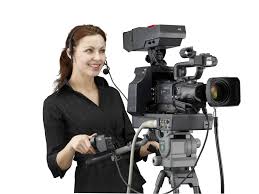
TELEVISION STUDIO CAMERA.

elevision is more concerned with the right visuals. Without visuals  the spoken words would look meaningless.
It is the job of the scriptwriter to match the words with the pictures and pass them on to the news readers.

Video Tape
The modern day’s video tape which records a story visually.  When colour TV came to existence chromatic film came to be used . Video tape as it comes now is cheap, light sensitive and also reusable. Video tape has totally replaced film. The video tape is the standard materials used worldwide.

Video Cassette
TV Cameramen usually use 20 minute cassettes because of weight size of the videotape is ¾ inch technically known as U-Matic. Video cassette is sealed at factories. Since the tape is not to be touched by bare hand. Also it will cause to damage the tape also editing machines. Because all the editing work  is done electronically. The sound and picture are on separate tracks on the tape. Thos enables video editors rearrange them separately also make possible pictures and sound can be edited separately.

The Television programs are provided in all the TV channels that the requirement and tastes of viewers. The provision of entertainment programmes in many forms such as songs, dances, cartoons, cinema, and drama. The channels ensure that all classes and categories of their viewers are altered. A videographer shooting for TV must frames his shot a bit smaller than the TV screen to prevent any loose in the total frame when screened.  The tape prepared by the videographer is the first generation tape. When this edited and transferred to another tape . It is became the second generation tape . Any copies made of this tape become the third generation tape.

A cameraman uses shots to narrate his story visually. Among these are the long shot the mid long shot  the medium shot , close up and very close shot.
Other functions that are necessary to obtain high-quality pictures include gamma correction, aperture correction, registration, and color balance. Gamma correction is required because the pickup devices do not respond linearly to increasing light levels. It allows the camera to capture detail in the dark areas of high-contrast scenes, essentially by “stretching” the video levels in those areas. Aperture correction provides several benefits mainly related to an even overall response to scenes with more or less detail. It also helps to improve the signal-to-noise ratio of the camera's output video. Registration must be adjusted on multiple-tube cameras to ensure that the separate red, blue, and green images are precisely aligned on one another; charge-coupled-device cameras are usually registered once, at the factory. Color balance must be properly set on color cameras and must be consistent from dark scenes to bright scenes, or there will be an objectionable tint to the camera output.
Studio cameras are equipped with several ancillary systems to enhance their operation. An electronic viewfinder (actually a small television monitor) shows the camera operator what the camera is seeing, making it possible to frame and focus the picture.
The tally system consists of one or more red lights that illuminate when the camera's picture is “on the line” so that production and on-camera personnel know which camera is active. Generally an intercom system is built into the camera so that the director can communicate with the camera operator. 

The camera itself may be mounted upon a tripod, but more often it is on a dolly and pedestal, which allows the camera to be moved around on the studio floor and raised or lowered as desired. A pan head permits the camera to be rotated to the left or right and furnishes the actual mounting plate for the camera. The lens zoom and focus controls are mounted on a panning handle convenient to the operator.

Telecine cameras are used in conjunction with film or slide projectors to televise motion pictures and still images. Many of the usual controls are automatic so as to require less operator attention.

Portable cameras usually combine all of the basic elements into one package and may be used for a multitude of purposes. They have found their way into electronic news gathering for broadcast television, and into electronic field production, where they can be used for production of broadcast programs, commercials, and educational programs. The units often have built-in microphones, videocassette recorders, and batteries for completely self-contained operation.

Cameras used in high-definition television (HDTV) are fundamentally similar in appearance and operation to previous cameras. In fact, some modern cameras are switchable to produce either a conventional output or an HDTV output. The conventional output has a 4:3 aspect ratio raster and the scan rates match the 525-horizontal-line, 59.94-Hz-vertical-field-rate NTSC standard in the United States. When switched to HDTV mode, the aspect ratio becomes 16:9 and the horizontal scan rate is usually increased to either 720 progressively scanned lines or 1080 interlace-scanned lines with a 60-Hz vertical field rate. See also Television


T

The zoom line that cameraman uses enables him to take either a long shot or very close shot without moving camera but only by manipulating the lens.  The zoom lens are rarely used in TV news coverage. It is  useful only for focusing on a man’s face and fingers on documents.  The pan shot moves horizontally to the left or right as required.
The tilt shot covers the scene up or down. The pan shot and the tilt shot are used while shooting conferences meeting  or rallies.  They are not cared generally when the news values of a picture is not important not its quality. It is generally the news writer who selects the best shots available, both  from  the journalistic point  of view and  also visually. In case of smaller stations or channels the cameraman himself is expected to do the editing.


Use of Sound

Direct sound. Live sound. This may have a sense of freshness, spontaneity and 'authentic' atmosphere, but it may not be acoustically ideal.
Studio sound. Sound recorded in the studio to improve the sound quality, eliminating unwanted background noise ('ambient sound'), e.g. dubbed dialogue. This may be then mixed with live environmental sound.
Selective sound. The removal of some sounds and the retention of others to make significant sounds more recognizable, or for dramatic effect - to create atmosphere,  meaning and emotional nuance. Selective sound (and amplification) may make us aware of a watch or a bomb ticking. This can sometimes be a subjective device, leading us to identify with a character: to hear what he or she hears. Sound may be so selective that the lack of ambient sound can make it seem artificial or expressionistic.
Sound perspective/aural perspective. The impression of distance in sound, usually created through the use of selective sound. Note that even in live television a microphone is deliberately positioned, just as the camera is, and therefore may privilege certain participants. 

Sound bridge. Adding to continuity through sound, by running sound (narration, dialogue or music) from one shot across a cut to another shot to make the action seem uninterrupted. 

Dubbed dialogue. Post-recording the voice-track in the studio, the actors matching their words to the on-screen lip movements. Not confined to foreign-language dubbing. 

Wildtrack (asynchronous sound). Sound which was self-evidently recorded separately from the visuals with which it is shown. For example, a studio voice-over added to a visual sequence later. 

Parallel (synchronous) sound. Sound 'caused' by some event on screen, and which matches the action. 

Commentary/voice-over narration. Commentary spoken off-screen over the shots shown. The voice-over can be used to:
§  introduce particular parts of a programme;
§  to add extra information not evident from the picture;
§  to interpret the images for the audience from a particular point of view;
§  to link parts of a sequence or programme together.
The commentary confers authority on a particular interpretation, particularly if the tone is moderate, assured and reasoned. In dramatic films, it may be the voice of one of the characters, unheard by the others.
Sound effects (SFX). Any sound from any source other than synchronised dialogue, narration or music. Dubbed-in sound effects can add to the illusion of reality: a stage- set door may gain from the addition of the sound of a heavy door slamming or creaking.
Music. Music helps to establish a sense of the pace of the accompanying scene. The rhythm of music usually dictates the rhythm of the cuts.. Conventionally, background music accelerates for a chase sequence. Through repetition it can also link shots, scenes and sequences. It may be a more credible and dramatically plausible way of bringing music into a programme than background music.
Silence. The juxtaposition of an image and silence can frustrate expectations, provoke odd, self-conscious responses, intensify our attention, make us apprehensive, or make us feel dissociated from reality.
Dynamic and condenser mics
It's important to choose the proper mic type and polar pattern. Dynamic microphones work on electromagnetic induction and are comparatively simple in design
The manufacturers of some field recorders recommend using condenser mics to provide a better signal-to-noise ratio from the recorders' microphone preamps. Condenser mic design has come a long way, but for pickup of loud sound sources like musical instrument amplifiers, a dynamic mic is less likely to produce SPL overload and distortion because it doesn't have an internal preamplifier.
However, many of the newer condenser microphones have a switch on the case that can attenuate the signal by 10dB or 20dB for loud source pickup. Wireless mic body pack transmitters have a similar attenuation switch inside the case, and this is typically used when the transmitter is employed with an electric guitar or similar instrument with a higher output than the microphone.

Pattern and frequency
The second basic consideration is the pattern. Any new microphone should come with a polar pattern the directionality at various frequencies and the effect of pattern-changing switches. This should always be accompanied by a frequency response graph.
Due to basic audio frequency physics, microphones are less directional as the frequency goes toward bass. Low-frequency sounds penetrate, while higher audio frequencies bounce off solid objects like walls. In real-world use, microphones represent a typical case in which you don't get something for nothing. There is always a trade-off, and this is the essence of experience in microphone selection.
Omni directional microphones are less sensitive to breath popping and sound coloration when used for close-up handheld vocal applications, such as a reporter doing a standup in a high-noise environment.
Cardioids microphones pick up less background ambient sound, but require thicker (and more obtrusive) pop filters. Also, they tend to have a proximity effect that emphasizes bass when held close to the mouth. Singers often use this effect to their advantage.
Shotgun or hyper cardioids microphones provide a tighter pattern but emphasize the proximity effect. For this reason, these types are used in situations where the microphone can't be placed close to the sound source.
Hyper cardioids podium microphones can help prevent PA system howling by providing more gain before feedback, and this is a typical case in which the correct microphone choice should come before twisting any EQ knobs on the mixer. One hallmark of inexperienced sound operators is that they tend to think that EQ knobs only turn to the right.

Levels and power
Microphone lines carry weak, tiny signals that are vulnerable to inductive noise and hum from motors, lighting dimmer packs and ground loops. Balanced lines help reject induced noise. However, the best defense against background AC hum and other sound system trash is to kick up the signal level at the earliest possible point with a preamp.
A good battery-operated preamp can sometimes be placed inside a podium and supply the phantom power necessary for condenser mics. Most include a limiter, and gain can be adjusted, usually in 5db to 10dB steps. Many of the newer digital snakes also have preamps built into the snake head, and these may be remotely operated. Any time a mic signal is being split for separate house, broadcast or stage monitor feeds, the splitter should include a direct path for mixer-supplied phantom power and a transformer isolated path with a switchable ground lifter. Every sound kit needs to have one because it can also be used to isolate powered speakers and other sound gear that may get its power from an AC source incompatible with that running the main mixer. Phantom power levels typically run from 12V to 48V, and the higher the original sound levels, the higher the voltage on the phantom power that may need to be used. Podium microphones for normal speech can usually get by on 12V phantom power.

Coincident pair
Among the more frequently used techniques of mic placement for stereo recording is the coincident pair using two cardioid pattern microphones angled at about 90 degrees with the capsules placed as closely together as possible without touching. This works particularly well for recording sources that are spread out over a wide area, such as symphony orchestras, studio audiences and crowds at sports events. (See Figure 1.)
Figure 1. Stereo Mics Select image to enlarge
Parabolic mics used on football games can also have a noticeable effect on the crowd ambience because they are normally heavy on upper middle frequencies due to the size of the parabolic bowl. Parabolic mic faders should be treated like an airplane throttle — smoothly up and smoothly down.

Panel talk with lapel mics
The electret condenser lapel mics used on talk shows can be either omnidirectional or cardoid, but once again there is a trade-off. With half a dozen guests on the set, cardioids sound less reverberant but usually require pop filters.

Television Journalism

News


The journalism's role at the time was to act as a mediator or translator between the public and policy making elites. The journalist became the middleman. When elites spoke, journalists listened and recorded the information, edited it, and passed it on to the public for their consumption. His reasoning behind this was that the public was not in a position to deconstruct the growing and complex flurry of information present in modern society, and so an intermediary was needed to filter news for the masses. The public is not smart enough to understand complicated, political issues. Furthermore, the public was too consumed with their daily lives to care about complex public policy. Therefore the public needed someone to interpret the decisions or concerns of the elite to make the information plain and simple. The journalist's role was to inform the public of what the elites were doing. It was also to act as a watchdog over the elites, as the public had the final say with their votes.
Journalists should do more than simply pass on information. He believed they should weigh the consequences of the policies being enacted. Over time, his idea has been implemented in various degrees, and is more commonly known as "community journalism".
This concept of community journalism is at the centre of new developments in journalism. In this new paradigm, journalists are able to engage citizens and the experts/elites in the proposition and generation of content.
journalism's first loyalty is to the citizenry, journalists are obliged to tell the truth and must serve as an independent monitor of powerful individuals and institutions within society. The essence of journalism is to provide citizens with reliable information through the discipline of verification, as well providing a forum for public criticism.

Television

Television (TV) news is considered by many to be the most influential medium for journalism. For most of the American public, local news and national TV newscasts are the primary news sources. Not only the numbers of audience viewers, but the effect on each viewer is considered more persuasive, as described by Marshall McLuhan ("the medium is the message" in his book Understanding Media). Television is dominated by attractive, with short soundbites and fast "cuts" (changes of camera angle). Television journalism viewership has become fragmented, with the 24-hour united States cable news television channels such as Cable News Network (CNN) starting in 1980, Fox News Channel and MSNBC in the 1990s.

Local Television

The industry divides television into local .  Such television markets are defined by viewing area and are ranked by the number of audience viewers.
Ttypically broadcast local news 3 or 4 times a day . News anchors are shown sitting at a desk in a television studio. The news anchor read teleprompters that contain local interest stories and breaking news. Reporters frequently tell their stories outside the a formal television studio in the field, where the news is occurring, in a remote broadcast setting where Electronic news-gathering (ENG) techniques are used with production trucksDaytime television or morning shows include more "soft" news and feature pieces, while the evening news emphasizes "hard" news.
News anchors, serve as masters of ceremonies and are usually shown facing a professional video camera in a television studio while reading unseen teleprompters. The anchors are often in pairs (co-anchors) sit side by side, often alternating their reading. Meteorologists stand in front of chroma key backgrounds to describe weather forecasting and show "graphics" (maps, charts, and pictures). Any of those people can become the most recognizable television personality of the television station. Reporters research and write the stories and sometimes use video editing to prepare the story for air into a "package". Reporters are usually engaged in Electronic field production (EFP) and are accompanied by a videographer at the scenes of the news. The latter holds the camera. That person or assistants manage the audio and lighting. They are in charge of setting up live television shots and might edit using a non-linear editing system  too. The segment producer might choose, research, and write stories, as well as deciding the timing and arrangement of the newscast. An associate producer, if any, might specialize in elements of the show such as graphics.

Production

A newscast director is in charge of television show preparation, including assigning camera and talent positions on the set, as well as selecting the camera shots and other elements for either recorded or live television video production. The Television Director operates the video switcher which controls and mixes all the elements of the show. At smaller stations, the Director and Technical Director are the same person.
A graphics operator operates a character generator that produces the lower third on-screen titles and full-page digital on-screen graphics. The audio technician operates the audio mixing console. The technician is in charge of the microphones, music, and audio tape. Often, production assistants operate the teleprompters and professional video cameras, and serve as lighting and rigging technicians ("grips").

Interactive

Convergence is the sharing and cross-promoting of content from a variety of media, which in theory might all converge and become one medium eventually. In broadcast news, the Internet is key part of convergence. Frequently, broadcast journalists also write text stories for the Web, usually accompanied by the graphics and sound of the original story. Web sites offer the audience an interactive form where they can learn more about a story, can be referred to related articles, can offer comments for publication, and can print stories at home, etc. Technological convergence also lets newsrooms collaborate with other media. Broadcast outlets sometimes have partnerships with their print counterparts.