Socrates

"The only true wisdom is in knowing you know nothing." 

Socrates

"To find yourself, think for yourself."

Nelson Mandela

"Education is the most powerful weapon which you can use to change the world."

Jim Rohn

"Success is nothing more than a few simple disciplines, practiced every day." 

Buddha

"The mind is everything. What you think, you become." 

Sunday, 28 December 2014

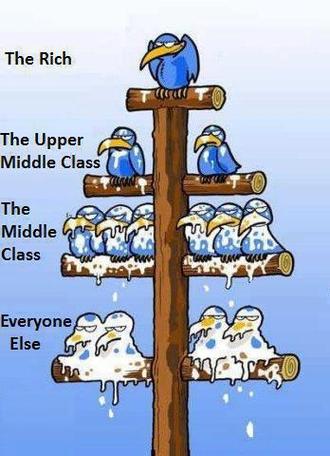
Social stratification according to class

 Class-Stratification on the basis of class is dominant in modern society. The lower class
The working class
The middle class
The middle class are the “sandwich” class. They divide into two levels according to wealth, education, and prestige. 
 The upper class
Property:Karl Marx assigned industrial society two major and one minor classifications: the bourgeoisie (capitalist class), petite bourgeoisie (small capitalist class), and proletariat (worker class). Marx made these divisions based on whether the “means of production” such as factories, machines, and tools are owned, and whether workers are hired. 
Income refers to the money that people receive over a certain period of time, including salaries and wages.
 Power: The second basis of social stratification is power, or the capacity to influence people and events to obtain wealth and prestige. That is, having power is positively correlated with being rich, as evidenced by the domination of wealthy males in highranking governmental positions. Because wealth is distributed unequally, the same is clearly true of power. 
 Prestige:A final basis of social stratification is the unequal distribution of prestige, or an individual's status among his or her peers and in society. Although property and power are objective, prestige is subjective, for it depends on other people's perceptions and attitudes. And while prestige is not as tangible as money and influence, most Americans want to increase their status and honor as seen by others.

The lower class is typified by poverty, homelessness, and unemployment. People of this class, few of whom have finished high school, suffer from lack of medical care, adequate housing and food, decent clothing, safety, and vocational training. The media often stigmatize the lower class as “the underclass”.

The working class  are those minimally educated people who engage in “manual labor” with little or no prestige. 
Unskilled workers in the class—dishwashers, maids, and waitresses—usually are underpaid and have no opportunity for career advancement. They are often called the working poor.
Skilled workers in this class—carpenters, plumbers, and electricians—are often called blue collar workers. They may make more money than workers in the middle class—clerks ,teachers, and computer technicians; however, their jobs are usually more physically taxing, and in some cases quite dangerous. 

The lower middle class is often made up of less educated people with lower incomes, such as private company workers, small business owners, privates school teachers.
The upper middle class is often made up of highly educated business and professional people with high incomes, such as doctors, lawyers, stockbrokers, and CEOs.

This class divides into two groups: lowerupper and upperupper. The  upper class are exceptionally rich. Both groups have more money than they could possibly spend, which leaves them with much leisure time for cultivating a variety of interests. They live in exclusive neighborhoods, gather at expensive social clubs, and send their children to the finest schools. As might be expected, they also exercise a great deal of influence and power both nationally and globally.
The lowerupper class includes those with “new money,” or money made from investments, business ventures, and so forth. 
The upperupper class includes those aristocratic and “highsociety” families with “old money” who have been rich for generations. These extremely wealthy people live off the income from their inherited riches. The upperupper class is more prestigious than the lowerupper class.


Estate system of medieval Europe provides another system of stratification which gave much emphasis to birth as well as to wealth and possessions. Each estate had a state.

Capitalists are those who own the methods of production and employ others to work for them. 
Workers are those who do not own the means of production, do not hire others, and thus are forced to work for the capitalists.
Small capitalists are those who own the means of production but do not employ others. These include selfemployed persons, like doctors, lawyers, and tradesmen.

 Slavery had economic basis. In slavery, every slave had his master to whom he was subjected. The master’s power over the slave was unlimited.

Wealth refers to the assets and incomeproducing things that people own: real estate, savings accounts, stocks, bonds, and mutual funds.

Occupation is one means by which prestige can be obtained. In studies of occupational prestige, For example, being a physician ranks among the highest on the scale, whereas being a shoe shiner ranks near the bottom.The way people rank professions appears to have much to do with the level of education and income of the respective professions. As a result, individuals who experience such status inconsistency may suffer from significant anxiety, depression, and resentment.

“Social stratification: meaning, types, and characteristics”

In all societies people differ from each other on the basis of their age, sex and personal characteristics. Human society is not homogeneous but heterogeneous. Apart from the natural differences, human beings are also differentiated according to socially approved criteria.

Meanings:

Social stratification is a particular form of social inequality. All societies arrange their members in terms of superiority, inferiority and equality. Stratification is a process of interaction or differentiation whereby some people come to rank higher than others.
Social stratification means division of society into different strata or layers. It involves a hierarchy of social groups. Members of a particular layer have a common identity. They have a similar life style. The Indian Caste system provides an example of stratification system.
Modern stratification fundamentally differs from stratification of primitive societies. Social stratification involves two phenomena
(i)                differentiation of individuals or groups on the basis of possession of certain characteristics whereby some individuals or groups come to rank higher than others,
ii) the ranking of individuals according to some basis of evaluation.
Sociologists are concerned not merely with the facts of social differences but also with their social evaluation.

Definitions:

According to  Ogburn and Nimkoff: ‘The process by which individuals and groups are ranked in more or less enduring hierarchy of status is known as stratification”

According  Williams:Social Stratification refers to “The ranking of individuals on a scale of superiority-inferiority-equality, according to some commonly accepted basis of valuation.


Origin of Stratification:

 (i) According to Davis, social stratification has come into being due to the functional necessity of the social system.
(ii) Professor Sorokin attributed social stratification mainly to inherited difference in environmental conditions.
(iii) According to Karl Mrax, social factors are responsible for social strata, i.e. social stratification.
  (vi) Racial differences accompanied by dissimilarity also leads to stratification.

Types of Social Stratification:

Social stratification is based upon a variety of principles. So we find different type of stratification.
The major types of stratification are
(i) Caste
(ii) Class
(iii) Estate

(iv) Slavery

Characteristics of Social Stratification


Social stratification is a particular form of social inequality. All societies arrange their members in terms of superiority, inferiority and equality. Stratification is a process of interaction or differentiation whereby some people come to rank higher than others.
Social stratification means division of society into different strata or layers. It involves a hierarchy of social groups. Members of a particular layer have a common identity. They have a similar life style. The Indian Caste system provides an example of stratification system.

(a) Social stratification is universal:

There is no society on this world which is free from stratification. Modern stratification differs from stratification of primitive societies. It is a worldwide phenomenon. According to Sorokin “all permanently organized groups are stratified.”
(b) Stratification is social:
It is true that biological qualities do not determine one’s superiority and inferiority. Factors like age, sex, intelligence as well as strength often contribute as the basis on which statues are distinguished. But one’s education, property, power, experience, character, personality etc. are found to be more important than biological qualities. Hence, stratification is social by nature.
(c) It is ancient:
Stratification system is very old. It was present even in the small wondering bonds. In almost all the ancient civilizations, the differences between the rich and poor, humble andpowerful existed. During the period of Plato and Kautilya even emphasis was given to political, social and economic inequalities.
(d) It is in diverse forms:
The forms of stratification is not uniform in all the societies. In the modern world class, caste and estate are the general forms of stratification. In India a special type of stratification in the form of caste is found. The ancient Aryas were divided into four varnas: the Brahmins, Kshatriyas, Vaishyas and Sudras. The ancient Greeks were divided into freemen and slaves and the ancient Romans were divided into the particians and the plebians. So every society, past or present, big or small is characterized by diversed forms of social stratification.
(e) Social stratification is Consequential:
Social stratification has two important consequences one is “life chances” and the other one is “life style”. A class system not only affects the “life- chances” of the individuals but also their “life style”.
The members of a class have similar social chances but the social chances vary in every society. It includes chances of survival and of good physical and mental health, opportunities for education, chances of obtaining justice, marital conflict, separation and divorce etc.

Life style denotes a style of life which is distinctive of a particular social status. Life-styles include such matters like the residential areas in every community which have gradations of prestige-ranking, mode of housing, means of recreation, the kinds of dress, the kinds of books, TV shows to which one is exposed and so on. Life-style may be viewed as a sub-culture in which one stratum differs from another within the frame work of a commonly shared over-all culture.

The definitions of society and culture


The society is to refer to members of specific groups. For example,  Teacher's Society, and Students society and the like. 
What is Society
false consciousness
x


A society is intangible; it is a process rather than a thing, motion rather than structure". Society is a web of social relationships, the pattern of norms of interaction by which the members of the society maintain themselves.


Society not only continues to exist by transmission, by communication, but it may fairly be said to exist in transmission, in communication.” — John Dewey in Democracy and Education, 1916

Definition of society:
Some definitions of the term "society" are given below:
Sociologists define society as the people who interact in such a way as to share a common culture. The term  refer to people who share a common culture in a particular location. For example, people living in Tirunelveli developed different cultures from those living in Chennai cultures. In time, a large variety of human cultures arose around the world.

Culture and society are intricately related. A culture consists of the “objects” of a society, whereas a society consists of the people who share a common culture. 

society is a very large group of people organized into institutions held together over time through formalized relationships. Nations, for example, are made up of formal institutions organized by law. Governments of different size, economic institutions, educational institutions and others all come together to form a society.

Individual is the basic component of society. The interaction of individuals with each other gives birth to group. The social groups interact with each other and develop relationships with each other, leads to a society. 

Meaning of Society

This term has been derived from a Latin word ‘socious’ that means association or companionship. Thus society means ‘A larger group of individuals, who are associative with each other’.


Prof Wright: It is a system of relationships that exists among the individuals of the groups.
Linton: Any group of people who have lived and worked together long enough to get themselves organized and to think of themselves as a social unit with well defined limits”.
“Society as a whole is more and more splitting up into two great hostile camps, into two great classes directly facing each other—Bourgeoisie and Proletariat” (Marx and Engels 1848
Maclver and Page:
"Society is a system of usages and procedures, authority and mutual aid, of many groupings and divisions, of human behavior and of liberties"
Cooley:
“Society is a complex of forms or processes each of which is living and growing by interaction with the other, the whole being so unified that what takes place in one part affects all the rest".

Marx:
Marx described modern society in terms of alienation. Alienation refers to the condition in which the individual is isolated and divorced from his or her society, work, or the sense of self. Marx defined four specific types of alienation.
Alienation from the product of one’s labor. An industrial worker does not have the opportunity to relate to the product he labors on. 
Alienation from the process of one’s labor. A worker does not control the conditions of her job because she does not own the means of production.  Everything is decided by the bourgeoisie who then dictate orders to the laborers.
Alienation from others. Workers compete, rather than cooperate: Employees vie for time slots, bonuses, and job security. 
Alienation from one’s self. A final outcome of industrialization is a loss of connectivity between a worker and her occupation. Because there is nothing that ties a worker to her labor, there is no longer a sense of self. Instead of being able to take pride in an identity such as being a watchmaker, automobile builder, or chef, a person is simply a cog in the machine.
Another idea that Marx developed is the concept of false consciousness. False consciousness is a condition in which the beliefs, ideals, or ideology of a person are not in the person’s own best interest. In fact, it is the ideology of the dominant class (here, the bourgeoisie capitalists) that is imposed upon the proletariat. Ideas such as the emphasis of competition over cooperation, or of hard work being its own reward, clearly benefit the owners of industry. Therefore, workers are less likely to question their place in society and assume individual responsibility for existing conditions