Socrates

"The only true wisdom is in knowing you know nothing." 

Socrates

"To find yourself, think for yourself."

Nelson Mandela

"Education is the most powerful weapon which you can use to change the world."

Jim Rohn

"Success is nothing more than a few simple disciplines, practiced every day." 

Buddha

"The mind is everything. What you think, you become." 

Thursday, 1 August 2024

2024 winners for Photography

Behaviour - Birds


TRACEY LUND - Gold WINNer and grand prize of WORLD NATURE PHOTOGRAPHER OF THE YEAR

Taken whilst on holiday in Shetland, sat on the side of a RIB. The hired DSLR camera in the waterproof housing was attached to polecam system and lowered into the water. Thousands of gannets were in the sky above us and then started to dive into the sea after local fish. An unbelievable spectacle to witness, let alone photograph. I took 1800 images on that day but only had 2 that I could use.


silver: Lakshitha Karunarathhna, SRI LANKA


bronze: JOUNI EROLA, FINLAND


Animal portraits


gold: NICOLAS REMY, australia


Friday, 7 June 2024

Photography Composition( Q/N)


1.      What is the primary function of composition in photography?

    • A) To capture light
    • B) To arrange visual elements pleasingly
    • C) To set the camera's exposure
    • D) To develop film

2.      How does Adam Long describe photo composition?

    • A) A technical arrangement of camera settings
    • B) A pleasing arrangement of objects within a rectangle
    • C) The process of editing photos
    • D) The use of special effects in photography

3.      Why is composition compared to the skeleton of a human body in photography?

    • A) It provides a rigid structure to the photo
    • B) It keeps everything together, supports the visual elements, and makes the frame look dynamic
    • C) It determines the color balance
    • D) It dictates the type of camera to use

4.      What does the rule of thirds in photography composition entail?

    • A) Placing the main subject in the center of the frame
    • B) Dividing the image into nine equal parts using two horizontal and two vertical lines and placing objects along these lines or intersections
    • C) Using only three colors in the photo
    • D) Limiting the number of subjects to three

5.      What are leading lines in photography composition?

    • A) Lines that lead the viewer’s eye from one part of a composition to another
    • B) Lines that separate different sections of a photo
    • C) Borders around the main subject
    • D) Lines that are always horizontal

6.      Which types of lines are identified as leading lines based on their direction?

    • A) Vertical, horizontal, or diagonal
    • B) Curved or straight
    • C) Zigzag or spiral
    • D) Dotted or dashed

7.      Which of the following can be used as leading lines in a photograph?

    • A) Shadows
    • B) Roads, fences, and bridges
    • C) Clouds
    • D) Light sources

8.      How is the "frame within the frame" technique used in photography?

    • A) By using the camera’s viewfinder to compose the image
    • B) By placing elements in the photograph that create a secondary frame around the subject
    • C) By using a photo editing software to add a frame
    • D) By shooting through a physical frame like a window

9.      How do camera manufacturers assist photographers in applying the rule of thirds?

    • A) By providing pre-set photo filters
    • B) By including the capability to display a grid in live view mode
    • C) By recommending specific lenses
    • D) By offering built-in tutorials on composition

10.  What is the effect of vertical leading lines in a photograph?

    • A) They create a sense of width
    • B) They add depth and invite the viewer on a journey through the scene
    • C) They create a sense of stability
    • D) They make the subject appear larger

11.  How do curved leading lines affect a viewer’s experience compared to straight leading lines?

    • A) They make the photo appear more rigid
    • B) They offer a sense of flow and grace that straight lines rarely achieve
    • C) They divide the photo into distinct sections
    • D) They create confusion

12.  How can horizontal leading lines be used to create a dynamic composition?

    • A) By creating a sense of movement across the photo
    • B) By making the subject appear taller
    • C) By adding a sense of depth
    • D) By emphasizing the color balance

13.  Describe a scenario where breaking the rule of thirds might be artistically effective.

    • A) Placing the main subject in the exact center of the frame for symmetry
    • B) Using only black and white tones
    • C) Focusing on a single color in the photograph
    • D) Blurring the background

14.  Which of the following was used as leading lines in the provided examples of a church?

    • A) The sky
    • B) The patterns on the paving wood
    • C) The door of the church
    • D) The people in front of the church

15.  How does the color contrast of plants in a tea bush path serve as leading lines in a photograph?

    • A) By creating shadows
    • B) By highlighting the path between the tea bushes
    • C) By blending into the background
    • D) By focusing on a single plant
  1. What is the primary function of composition in photography?
  2. How does Adam Long describe photo composition?
  3. Why is composition compared to the skeleton of a human body in photography?
  1. Explain the rule of thirds in photography composition.
  2. What are leading lines, and how do they function within a composition?
  3. How can leading lines vary in direction, and what effect does each direction have on a photograph?
  1. List five examples of objects or elements that can be used as leading lines in a photograph.
  2. Describe how the "frame within the frame" technique is used in photography.
  3. How do camera manufacturers assist photographers in applying the rule of thirds?
  1. Analyze the use of leading lines in a photograph of a road leading to the horizon.
  2. Discuss the impact of curved leading lines versus straight leading lines on the viewer’s experience.
  3. How can the use of vertical leading lines add depth to a photograph?
  1. How can a photographer create a dynamic composition using horizontal and diagonal leading lines?
  2. Describe a scenario where the use of the rule of thirds might be broken intentionally for artistic effect.
  3. How can different types of leading lines (e.g., fences, shorelines, trees) be combined in a single photograph to create a complex composition?
  1. Explain the use of leading lines in the provided examples of a church, a mountain, and a compound wall.
  2. How does the color contrast of plants in a tea bush path serve as leading lines in a photograph?


Thursday, 4 January 2024

Screenplay Format


Setting Up Your Document

  1. Screenwriting software: Final Draft, which is the world’s leading screenplay formatting software, and used in the offices of all the big executives, agents, producers and studios. 
  2. Paper: US screenplays are printed on Letter size paper, 8.5″ by 11″. The international standard for much of the rest of the world is A4, 8.27″ X 11.7″.
  3. Screenplay Font: Courier 12pt.
  4. Spacing: The spacing between lines alternates between single and double according to the type of text.
  5. Margins: The top and bottom margins are usually 1”, but the margins on the left and right vary according to what type of text it is.
  6. Cover page: Your cover page should include the title of your script, your name, and your contact information.
  7. Page number: Page numbers are located at the top to the far right. You do not need a page number on your first page.
  8. Page length: Screenplays are typically between 90 and 120 pages. One page is the approximate equivalent to one minute of screen time. Comedies tend to be around 90 pages, while dramas tend to be longer, at around 110 pages.


Getting Started with Screenplay Format

  1. Fade in/Fade out: At the  beginning of your screenplay, you need to include  “Fade in:” on the left side. You can also include your title again at the very top of this page before Fade In. At the  end of your script, you end with “Fade out.” on the right hand side, followed by THE END in the center of the next line.
  2. Scene headings: In screenplay format, scene headings are written in all uppercase and have at least three parts. The first is INT. or EXT. to indicate whether the scene is interior (inside a building) or exterior (outside). The second part is the location (for example, GROCERY STORE), followed by a hyphen. The third part is the time of day, usually just DAY or NIGHT. Example:Scene heading
  3. Description: A description usually follows the scene heading and is used to set the scene by providing visual details. This is written like prose and, like the rest of your screenplay, needs to be in the present tense. Description text is located 1.5” from the left.
  4. Action: When describing the action of a character, you follow the same screenplay format as for scene description.
  5. Introducing characters: When introducing a character, it is helpful to put the character’s name in all caps. It is also necessary to provide a brief description of the character, followed by their age. Here is an example/template:Character introduction
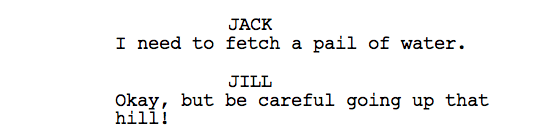
  6. Character: The character’s name always appears above the dialogue in all caps. This appears near the center of the document (3.5” from the left).
  7. Dialogue: The lines of speech are located 2.5” from the left and fall below the character’s name. Dialogue
  8. Parentheticals: Parentheses can be used in screenplay format between the character line and the dialogue (3.5” from the left) to describe the way the character says a line. For example, if it is unclear, you may have to indicate that a character is saying something sarcastically. Make sure and leave these cues as adverbs instead of adjectives. An example is shown below.Parentheticals
  9. Transitions: Transitions generally only appear in a shooting script, and are a way to describe getting from one scene to the next. Examples include “CUT TO:” and “DISSOLVE TO:”. They are located where “FADE IN:” would be but do not have to be the first thing on a page.
  10. Subheaders: Subheaders are used when an entirely new scene heading is not necessary, such as when a character moves from one room in a house to another. These should be used sparingly. To format these, write the new location in all caps on its own line.

Special Situations in Screenplay Format

  1. Sounds/props: Mainly reserved for shooting scripts, it is helpful to put props and sounds in all caps so prop masters and sound technicians can find them easily.
  2. Extensions: If a line of dialogue is being narrated or you cannot see the character, you can use (V.O.) for voice over or (O.S.) for off-screen. In screenplay format, these extensions are placed next to the character’s name.
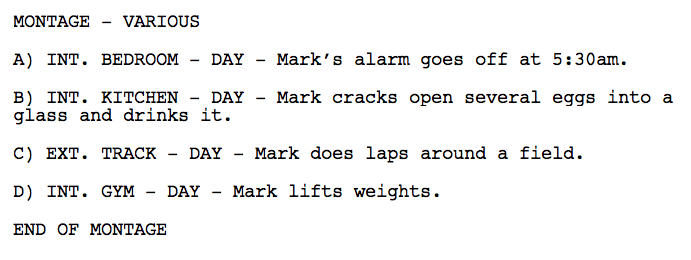
  3. Montages: To format a montage with a single location, type MONTAGE on its own line. Then below it, use hyphen bullet points to briefly describe each moment/image of the montage. Conclude with END OF MONTAGE on its own line. For a montage with multiple locations, use the following example:montage
  4. Flashbacks: In screenplay format, a flashback is introduced by inserting FLASHBACK TO: at the far right of the screenplay. Then you can insert your scene. When the flashback is over, write BACK TO PRESENT on a new line to the far left. When using flashbacks, it is useful to include the date in a parentheses as part of your scene headings (see example below).flashback
  5. Dreams: There are a couple ways to write a dream sequence in screenplay format. One way is to add (DREAM SEQUENCE) to your heading and END DREAM SEQUENCE to the left on its own line at the end. You can also format it like a montage if there are multiple parts to the dream.
  6. Phone calls: One way to format a phone call is to insert INTERCUT PHONE CONVERSATION before the dialogue begins. This indicates that the scene will go back and forth between showing each character on the phone.
  7. Text being read: When a character is reading something that the audience can see, you can indicate this using quotation marks and all caps: Sally picks up a note. Over her shoulder it reads, “PLEASE PICK UP MILK FROM THE STORE.”
  8. Parallel action: For parallel action, write INTERCUT on a line above the dialogue to indicate that the scene will go back and forth from showing different characters’ situations.
  9. More and Cont’d: If a line of dialogue is cut off and continues on the next page, (MORE) is placed on the bottom center of the first page and (CONT’D) is placed next to the character’s name on the next page. In screenplay format, (CONT’D) is also used next to a character’s name is they have two lines of dialogue that are separated by a line of action or description.
  10. Shots: Camera directions are only included in shooting scripts, not in spec scripts. They are found in the description. Examples include PAN TO and CLOSE UP ON.
  11. Superimposed text: To indicate that non-diegetic text will appear on the screen (that only the audience can see), write SUPER: “Text that is superimposed.”
  12. Underline: You can underline a word or line of text to emphasize it.

There are many components to screenplay format.  However, if you understand your screenplay format tools and use good writing software.


Thursday, 3 August 2023

Berlo’s Model of Communication- the SMCR model


 The Berlo’s model of communication takes into account the emotional aspect of the message. Berlo’s model of communication operates on the SMCR model.

In the SMCR model

  • S - Stands for Source
  • M - Message
  • C - Channel
  • R - Receiver

Let us now study the all the factors in detail:

S - Source

The source, also known as the sender, is the one who has the  thought originates. He is the one who transfers the information to the receiver after carefully putting his thoughts into words.

How does the source or the sender transfer his information to the recipient ?

the source or the sender transfer his information to the recipient  with the help of communication skills, Attitude, Knowledge, Social System and Culture.

  • Communication Skills

    An individual must possess excellent communication skills to make his communication effective and create an impact among the listeners. The speaker must know where to take pauses, where to repeat the sentences, how to speak a particular sentence, how to pronounce a word and so on. 

  • Attitude

    The sender must have the right attitude to create a long lasting impression on the listeners. An individual must be an Viscom graduate from a reputed institute, but he would be lost in the crowd without the right attitude.

  • Knowledge

     Knowledge is actually the clarity of the information which the speaker wants to convey to the receiver.  One must be thorough in what he is speaking with complete in-depth knowledge of the subject. 

  • Social System

    The listeners were irritated merely because the speaker ignored the social structure of the environment in which he was communicating. He had forgotten about the second party's sentiments, cultural beliefs, and religious convictions.

  • Culture

    The cultural background of the community or listeners with whom the speaker is communicating or delivering his speech is referred to as culture.

M - Message

When an individual converts his thoughts into words, a message is created. The process is also called as Encoding.

Any message further comprises of the following elements:

  • Content

     It is very important for the speaker to carefully choose the words and take good care of the content of the speech. The content has to be sensible, accurate, crisp, related to the thought to hit the listeners bang on and create an immediate impact.

    The substance or script of the talk is referred to as content. In other words, it is the foundation of any communication. 


     The speaker must carefully select his or her words and give special attention to the topic of the speech. To have an immediate impact on the listeners, the content must be sensible, precise, and succinct(succinct implies the greatest possible compression)

  • Element:  The speech must be coupled with lots of hand movements, gestures, postures, facial expressions, body movements to capture the attention of the listeners and make the speech impressive. Hand movements, gestures, postures, facial expressions, body movements, gestures all come under the elements of the message.

  • Treatment

    Treatment is actually the way one treats his message and is conveys to the listeners.  This is referred to as the treatment of the message. One must understand how to present his message so that the message is conveyed in the most accurate form.

  • Structure

    A message cannot be expressed in one go. It has to be properly structured in order to convey the message in the most desired form.

  • Code

    The communication code must be right. Your body movements, language, expressions, and gestures are the communication's codes, and they must be exact or the message will be corrupted and the recipient would never be able to decode the proper information.

C - Channel

Channel - Channel actually refers to the medium how the information flows from the sender to the receiver.


The five senses are represented by the channels Hearing, Tasting, Seeing, and Smelling.Touching. This allows humans to communicate with one another.


R - Receiver


For a smooth flow of information and a better grasp of the message, the receiver should be on the same platform as the speaker. He should have good communication skills in order to understand what the speaker is saying. He must have a positive mindset in order to comprehend the message. His knowledge should be on par with that of the audience, and he should be knowledgeable about the subject. He should have the same social and cultural background as the speaker.