Socrates

"The only true wisdom is in knowing you know nothing." 

Socrates

"To find yourself, think for yourself."

Nelson Mandela

"Education is the most powerful weapon which you can use to change the world."

Jim Rohn

"Success is nothing more than a few simple disciplines, practiced every day." 

Buddha

"The mind is everything. What you think, you become." 

Monday, 4 April 2022

EQUIPMENT FOR RADIO PRODUCTION


A radio station needs a number of equipments for producing and transmitting programmes.  

By definition, equipment are all the materials installed in the studio for the production of programmes, starting from furniture to digital equipment.

Some of the most common radio equipment are:

Transmitter

an antenna which beamed out  broadcast signals of a station. The transmitter has different range of coverage.  The short wave (SW) signals go very far others are medium wave (MW).

The microphones

A microphone can be regarded as an instrument which changes sound energy into electrical signals. Microphone as a device that converts or changes sound energy into electrical energy. This is a technology that amplifies and regulates the sound output in a programme. It converts the variation of sound pressure in a sound wave into corresponding electrical variation in an electric circuit.

There are basically two ways of distinguishing microphones.

(a) By the pickup pattern

(b) By the materials they are made with

(a) Pick Up Pattern: Microphone can be made so that they pick sound from one, two or all directions.


(i)
Directionality: Pickup Pattern


  • A.        Omnidirectional
  • B.        Bidirectional
  • C.  Unidirectional (Cardioid)


1.    Cardioid

2.    Super Cardioid

3.    Hyper Cardioid


Omnidirectional Mics


  • Equal output or sensitivity at all angles.
  • It will pick up maximum amount of ambient sound.
  • Should be placed close to the sound source to pick up a useable balance between direct sound and ambient sound.
  • Cannot be aimed away from undesired sources such as PA speakers which may cause feedback!


Bidirectional Mics


  • Maximum sensitivity at both 0 degrees (front) and 180 degrees (back).
  • Least amount of output at 90 (and/or 270 degree) angles (sides).
  • Used for picking up two opposing sound sources, such as a vocal duet.


Unidirectional Mics: Cardioid

  • Maximum sensitivity at both 0 degrees (on-axis).
  • Least sensitive at the rear (180 degrees off-axis)
  • Effective coverage or pickup angle: about 130 degrees.
  • Picks up about one-third as much ambient sound as an omni.
  • Isolate the desired on-axis sound from both unwanted off-axis sound and from ambient noise.


Dynamic Microphones

Also called moving-coil mic.

  • This classification includes ribbon mics (velocity mics).
  • Simple construction, economical.
  • Rugged, resistant to hand noise.
  • Require no batteries or power supply.
  • Standard equipment used by musical performers.
  • Handle extremely high sound levels.

1.     Sound waves strike the diaphragm.

2.     Diaphragm vibrates in response.

3.     The voice coil, attached with the diaphragm, vibrates with it.

4.     The voice coil is surrounded by a magnetic field created by the magnet.

5.     The motion of the voice coil in this magnetic field generates the electrical signal.


Condenser Microphones


  • Also called capacitor or electret condensor mic.
  • More complex than dynamics, tend to be costly.
  • Not as rugged as dynamic mics.
  • Can be affected by extreme temperature and humidity.
  • Require batteries or power supply.
  • Standard equipment used by film production.
  • Higher sensitivity, provides a smoother, more natural sound, particularly at higher frequency.

1.     Sound waves strike the diaphragm.

2.     Diaphragm vibrates in response, changing the space between itself and the metal or metal-coated-ceramic backplate.

3.     The variation of this spacing, due to the motion of the diaphragm relative to the backplate, produces the electrical signal.

 Electrical Impedance / Low-Z & High-Z Mics


  • After a microphone changes acoustic energy into electric energy, the electric energy flows through a circuit as voltage.
  • Whatever resistance that voltage encounters in the circuit is called impedance.
  • Impedance is expressed in ohms.
  • Less resistance means lower impedance.
  • Low-impedance (low-Z): 600 ohms or less.
  • High-impedance (high-Z): 10,000 ohms or higher.
  • Professionals prefer low-impedance mics.
  • Much less susceptible to hum and electric noise, such as static from motors and fluorescent lights.
  • Can be connected to long cables (over 1000 feet, so says Shure) with negligible loss of sound quality.
  • High-impedance mics usually begin to sound muffled due to a loss of high frequencies when used with a cable longer than 20 feet.


The Shotgun Microphone


A shotgun microphone, also known as a boom mic, is a long cylindrical microphone that is very directional. This means it won’t pick up as much background noise as most lavalier mics. The higher end shotgun microphones usually pick up more frequencies and sound better than comparable lav mics.

Saturday, 2 April 2022

THE ART OF PRESENTATION & News reading

 THE ART OF PRESENTATION News reading 

Creativity manifests itself into various art forms, such as, the art of painting, sculpturing, music, dance, drama and writing. "Talking" has also a  art form. The presenter has to master this form of art to describe a programme by using imagination and communication skills. To understand the 'Presentation Technique'


  Technique means art, method or procedure to render an artistic work.. Presentation is the packaging of the content of a radio programme.  The effective  Presentation,  Techniques, the good content and well written script are making the desired impact 

 A good presentation takes into account the objective of the programme, needs of the listener and a thorough understanding of the strengths and limitations of the medium. A good presentation answers all the queries of audience. The demands of audio medium make radio different and unique. 

 Radio is only heard in which neither the presenter nor the listener is visible. so that the presenter has to create an illusion of being with the listener. The main pillars on which the skill of presentation is the Innovation, creativity, freshness and novelty . The elements of rich vocabulary, information, knowledge and the ability to discern  as to what to say and what not to say make the program strong and sturdy.  Good presentation stems from an understanding of the medium and a basically caring attitude towards the listener. Presentation is radio’s packaging. It matters  a programmer's content, well written or excellent  interviews

CATEGORIES OF PRESENTERS 

Presenters  are representatives of the broadcasting organisation and act as links between the organlsation and the listeners.  A Presenter is expected to know all about the nature, content and mood of the programme which is  is golng to present. Presenter's job becomes crucial to develop rapport with the unseen listeners. 

The listeners spread over from urban, rural and far flung hilly areas and deserts differ in their Economic, Social, Cultural and Educational status.  To meet everybody's information,  entertainment needs is an uphill task.  A good radio presenter persuades the listeners and keeps them stay tuned for the entire programme. 


 News Reader

A newsreader must understands what is being read. A newsreader or presenter should to  ‘think outwards’, away from him/her self. The newsreader is expected to being friendly, respectful, informative and helpful. A newsreader should be well informed and have an excellent background knowledge of current affairs in order to cope when changes occur just before a bulletin

 The news reading tends to be more formal than a music programme, but there is room for a variety of approaches.The reader does not shout. If The reader was half a metre from the microphone and the listener is a metre from the radio, the total distance between the presenter is one and a half metres. The volume should be in an ordinary clarity.

The presenter is not  reading, but is talking with the listener. This small exercise in imagination is the key to good presentation

The seven Ps Here are the recognized basics of good presentation:

 
Posture. The sitting position comfortable, to allow good breathing and movement.  Cramped or slouching posture does not generally make for an easy alertness. 
2 Projection. vocal energy being used appropriate 
3 Pace. Too high a word rate can impair intelligibility or cause errors.
 4 Pitch. The voice should be used to convey natural meaning 

5 Pause. Suitable silences are used intelligently to separate ideas and allow understanding to take place. 

6 Pronunciation. get know the basics of phonetic guidelines. 
7 Personality. The sum total of all that communicates from microphone to loudspeaker,


Announcer 

An Announcer introduces different kinds of programmes scheduled for transmission. She gives adequate details of the items e.g., for a classical vocal or instrumental music programme, . A brief, catchy and appropriate introduction helps to set the pace of the programme and create interest among the listeners. 

Sometimes, an announcer acts as a presenter. She is known as 'Presentation Announcer' .The announcer has to do a lot of homework for the presentation. The details of the programme are given in the cue sheet of the transmission.

https://www.youtube.com/watch?v=-59vyKxt5wQ


Compere 

Comperes can be classified into 
special audience programme and 
Master of Ceremony.  The DJ adopts a distinctive style, it may be elegant or funny but remains consistent in each programme. In some programmes, A DJ has to make thorough preparations before making the presentation for optimum impact. 

Master of Ceremony

A compere presents special audience programmes such as Women and Children's programme, for villagers, industrial workers, armed forces etc. . Programmes conducted before invited audience are handled by an experienced, vibrant and witty announcer who is known as Master of Ceremony. S/he entertains the audience and keeps them involved as participants in the whole programme by adding some anecdotes, couplets or events related with the programme

https://www.youtube.com/watch?v=4XjFvru8n2c


PRE PRODUCTION Radio/Television

  There are some common elements in planning radio programmes in different formats though the methodology of planning certain programmes . The programmes such as drama, music, sports, and others.. 

Let us have a look at some of these common elements. 

 Identifying the Aim and Defining the Scope

 In planning an effective Televison/Radio programme, the most important step is to identify the broad aim of the programme - whether the intended programme imparts education, whether it is informative, aimed to generate awareness or enrichment type or entertaining in nature. Working out objectives of a radio programme in clear-cut terms is an important part of the planning process because your entire effort is geared towards achieving those objectives. When a decision is taken on producing a programme on a particular subject, the next stage is conceptualization. The producer has to draw an outline of the programme indicating the main focus and other aspects that need projection. The scope is the framework on which planning is organized. It reflects the need assessment of the programme and production requirements

Content Planning and Research

Content planning begins when we collect and collate all the material connected with a subject. Selecting the right material help in content planning which must ensure that the programme does full justice to the subject chosen. Overload of information may defect a programme.

 If the subject is vast, you may plan a series of programmes to do full justice to the topic instead of cramming all information in a single programme.

If the producer has to prepare a programme on drinkers, for example, s/he has to study the subject including health, legal, social, anthropological and other aspects and consult a number of experts in the area.

 If the subject is complex or technical, the producer has to engage an expert to provide research inputs.

 Selection of Format In radio language/Television Language

the word ‘format’ is used to refer to the form of the programme such as the talk format, the story format, the feature format and so on. The scripts can be written in many basic formats such as talk, feature or documentary. The selection of format depends on its suitability to express a given idea to a given audience.

Selection of Scriptwriter and Other Talents

 In radio broadcast most of what goes on the air is written in advance. If it is a programme in the talk format the producer selects a talker who writes Audio Production the script. In the case of a feature, the producer writes the script himself or engages a scriptwriter.


The selection of a script writer is of crucial importance.

The producer has to brief the scriptwriter on the scope of the programme and ensure that the script meets the requirements of the programme. If the producer gets a good script, half the ‘battle’ of making a good programme is won. 

HISTORY OF RADIO


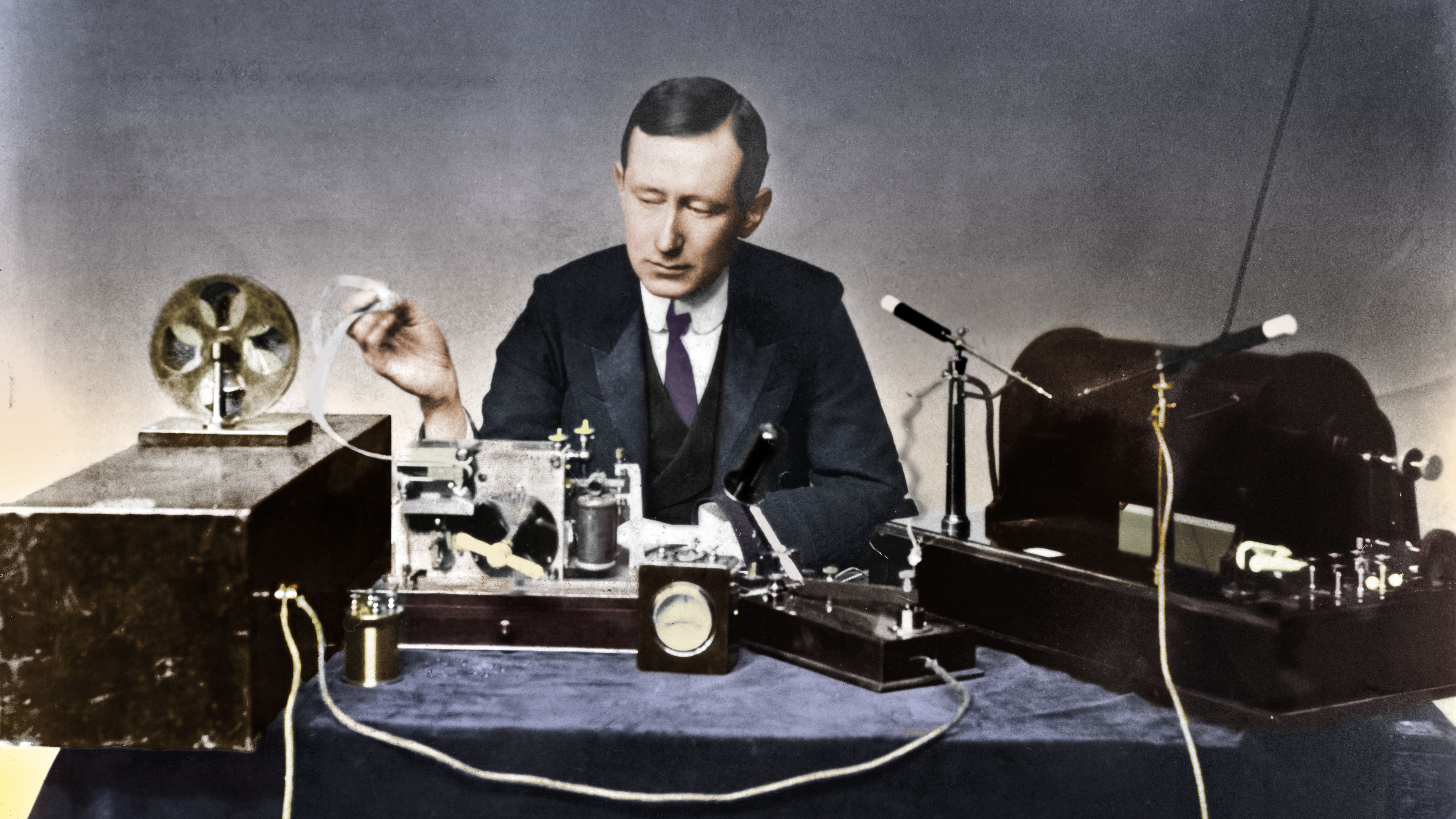
Historically speaking, Marconi started radio broadcasting in 1896 with the invention of first wireless telegraph link. It took ten years since then for the first demonstration of radio broadcasting to establish.  But it was hard to distinguish words from music.


Another successful demonstration took place from the Eiffel Tower in Paris in 1908.

A New York Station transmitted the first radio news bulletin in 1916 on the occasion of the election of US President.


By 1927, broadcasting services were started as a major medium of information.


Radio broadcasting in India began as a private venture in 1923 and 1924, when three radio clubs were established in Bombay, Calcutta and Madras (now Chennai).


The Radio Club broadcast the first radio programme in India in June 1923. The daily broadcasts of 2 to 3 hours consisted mainly of music and talks. These stations had to close down in 1927 for lack of sufficient financial support.


In India in July 1927 on an experimental basis at Bombay and a month later at Calcutta under an agreement between the Government of India and a private company called the Indian Broadcasting Company Ltd. 


Faced with a widespread public outcry against the closure of the IBC, the Government acquired its assets and constituted the Indian Broadcasting Service under the Department of Labour and Industries. Since then, broadcasting in India has remained under Government control.


In 1936, a radio station was commissioned in Delhi. In the same year, the Indian Broadcasting Service was renamed All India Radio (AIR) and a new signature tune was added. The Delhi station became the center of broadcasting at the national level.


When India became Independent, the AIR network had only six stations at Delhi, Bombay, Calcutta, Madras, Lucknow and Tiruchirapalli


Radio broadcasting assumed considerable importance with the outbreak of World War II. By 1939, During this period, news and political commentaries were introduced and special broadcasts were made for the people on the strategic north eastern and north western borders.


After independence, the broadcast scenario has dramatically changed with 198 broadcasting centers, including 74 local radio stations, covering more than 97.3 per cent of the country‘s population. Presently, it broadcasts programmes in a number of languages throughout the day.


Mostly the broadcasting centers are full-fledged stations with a network of medium wave, short wave and FM transmission. Besides, the external services Division of AIR are a link with different regions of world through its programmes in as many as 24 languages for about 72 hours a day.

PRESENT SCENARIO OF RADIO AND TELEVISION:

Presently, AIR is utilizing satellite services for transmission of its programmes throughout the country with a radio networking.

With the introduction of Radio Paging Service, FM transmitter has become the landmark of AIR.


Today, All India Radio counts among the few largest broadcasting networks in the world to serve the mass communication needs of the pluralistic population of India.


3- TIER BROADCASTING: All India Radio has evolved a three-tier system of broadcasting, namely, national regional and local. It caters to the information, education and entertainment needs of the people through its various stations spread over the length and breadth of the country.

They provide news, music, talks and other programmes in 24 languages and 146 dialects to almost the entire population of the country.


NEW SERVICES: “This is all India Radio. The News, read by.........." These words ring all over the country every hour, day and night, broadcasting news bulletins in Hindi, English and 17 regional languages.


The bulk of AIR news comes from its own correspondents spread all over the country It has 90 regulan correspondents in India and has seven special correspondents/reporters and two hundred and forty six part-time correspondents stationed in different countries.

REACH OF RADIO: 


All India Radio and Doordarshan are now part of the Praser Bharati the autonomous broadcasting corporation of India through an Act of Parliament in 1990.


The Prasar Bharati Board took charge of the administration of All India Radio and Doordarshan with effect from 23rd November 1997.


All India Radio presently has more than 200 Radio Stations including 183 full-fledged stations and nine relay centers and three exclusive Vivldh Bharati Commercial Centers.


In all AIR has 310 transmitters and provides radio coverage to a population of 97.3 per cent spread over 90 per cent area of the country.


All India Radio is broadcasting in 25 languages. Of these 16 are foreign and 9 are Indian languages.

The National Channel of All India Radio came on air on 18th May 1998. This Channel works as a night service from 6.50 pm to 6.10 a.m everyday, covering 64% area and almost 76% population.

FUTURE OF RADIO

In a developing country like ours, a special function of broadcasting should be

·         the coverage of development its significance, achievements and problems.

·         People‘s participation in development activities should be highlighted as also significant work being done by voluntary agencies.

·         The style and methods of news reporting should reinforce the fundamental principles on which national policies are based.

The primary purpose of the current affairs programmes should be to enlighten the people on various aspects of political, economic, social and cultural developments.


FM and Privatization of Radio: 


Two very important developments have taken place in the field of radio broadcasting in India.

With the advent of television the importance of radio had gradually diminished.


But it seems that radio is reappearing once again in the form of FM transmission.


The FM transmission stations are working as local stations catering to the local needs of the listeners:


The partial privatization of FM broadcasting has also made the radio an important medium of mass communication.

The programmes broadcast on FM are becoming very popular with the urban youth as the programmes cater specifically to them.


Moreover, FM broadcasts are also becoming popular in cars and other vehicles.


They provide necessary information regarding the roadblocks, traffic, and weather etc. to the motorists.


FM broadcasting has gained a lot of popularity in last few years.