Socrates

"The only true wisdom is in knowing you know nothing." 

Socrates

"To find yourself, think for yourself."

Nelson Mandela

"Education is the most powerful weapon which you can use to change the world."

Jim Rohn

"Success is nothing more than a few simple disciplines, practiced every day." 

Buddha

"The mind is everything. What you think, you become." 

Tuesday, 9 December 2014

5. Difference between Spec Script and Shooting Script!

The story is just the idea; the screenplay has actually fleshed it out into dialogue and scenes to be shot as the film . Screenplay means how the topic written in story will be shown on screen. The script(screen play) for a movie, including descriptions of scenes and some camera directions.  It has various parts like how the character & location should look. How it enter & leave frame. What is camera movement etc.  It is the text for a film, including the words to be spoken by the actors and instructions for the cameras .
A script is a document that outlines every aural(audio), visual, behavioral, and lingual element required to tell a story.  Film is a VISUAL medium through it we cannt  tell our audience our story, we SHOW them.  We can learn to write a screenplay VISUALLY. The discipline of screenplay writing is how to show it on a screen. So just write the pictures, sounds, and speeches, and leave the rest for the filmmakers.

What is a “Spec Script”?

Spec Script. This is a script written  on the speculative hope that it will be sold. A spec script  is a document submitted for the following considerations:
1. As a project for outright purchase or option.
2. As a sample so others can evaluate your talent for a potential rewrite or “polish” on a project .
3. As a sample to introduce a screenwriter to an agent/manager for possible representation.

Descriptive narrative:  Give just enough description to set the scene. 


EXAMPLE:

EXT. DESERT CANYON – SUNSET
A Gunman races through the rocky canyon, his horse leaving a cloud of dust in its wake.

Descriptive character action:  

It is a description about  movement or expression your characters makes,  as she sips her tea and pets her black cat. 

EXAMPLE:

INT. BEV’S STUDIO APARTMENT –  EVENING
Another difficult day behind her, Bev settles down with her cup of tea, her faithful black cat on her lap.

 Descriptive action sequences:  

Keep action scenes to a minimum.  No need to describe each thrust and parry as the two knights battle one another -- give just enough description to signal what the action is all about.  A major complaint from producers and execs is when action sequences are so heavily-detailed it becomes difficult to understand at first read.  Writers should keep it simple and allow the stunt coordinator and director to confer on the choreographic details, once your project is sold and green lit for production.
EXAMPLE:

Spec Screenplay Page Properties

The Rules:
Screenplays are traditionally written on 8 1/2" x 11" white 3-hole punched paper. A page number appears in the upper right hand corner (in the header). No page number is printed on the first page. The type style used is the Courier 12 font. The top and bottom margins are between .5" and 1". The left margin is between 1.2" and 1.6". The right margin is between .5" and 1".
The extra inch of white space on the left of a script page allows for binding with brads, yet still imparts a feeling of vertical balance of the text on the page.
The Courier 12 font is used for timing purposes. One script page in Courier 12 roughly averages 1 minute of onscreen film time. Experienced readers can detect a long script by merely weighing the stack of paper in their hand.
Script Length
The average feature screenplay, traditionally, is between 95 and 125 pages long. In Hollywood these days scripts generally don't run longer than 114 pages. Comedy scripts are typically shorter, dramas longer. There are, naturally, variations. You could be writing an action-packed film where your description takes only 10 seconds to read, but will take 45 seconds of film time. Here's an example:
125 page scripts are considered on the long side for a screenplay. Length is a very important component of the script. When we turn in a script to a producer, the very first thing they  will do is fan through the pages and look at the last page to see how long it is. It doesn't matter if you've written the most incredible screenplay ever, if it's too long they may refuse to read it.
The Industry's aversion to long scripts is due to economic considerations. Films under two hours mean more showings per day in a theater, which means more revenue for the exhibitor, distributor, filmmaker, and possibly even you, the screenwriter.
 Typical feature film scripts run from 100 to 120 pages, which means that each page averages one minute of screen time.
What is a “Shooting Script”?
 Once a script is purchased, it often goes through a series of rewrites before it is put into production. that script becomes a 'Shooting Script' or Production Script.
All the scenes and shots of a shooting script are numbered and each scene and shot are broken down into all the component pieces required to film it. The production assistants and director can then arrange the order in which the scenes will be shot for the most efficient use of stage, cast, and location resources.
Shooting scripts contain more pages than spec scripts.  Shooting scripts are more detailed and may include the following:
• Scene numbers
• Large number of camera angles/directions
• Detailed special effects
• Detailed stuntwork/action sequences
• Specific information on sets, costumes, lighting
• Special notations regarding acting


Film Script Terminology

Most of the following applies to both film scripts and television scripts.
The basic transitions from one scene to another are:
  • cuts - instantaneous changes from one scene to the next, as in "Cut to...."
     
  • lap-dissolves, also called dissolves - where two scenes momentarily overlap during a transition from one to the other
     
  • fade-out and fade-in -- fade-out consists of a two-or three-second transition from a picture to black and silence;  and, of course, a fade-in is the opposite
Traditionally, screenplays (dramatic film scripts) start with fade in and close withfade out.  Fade-ins and fade-outs within the production can signal a major change or division within the story structure, such as a passage of time. And, as we've noted, they can also indicate a division in the story structure where (for television) commercials are inserted.
An insert shot is a close-up of something within the scene. For example, after a man looks at his watch, you might see a cut to close-up of the watch where you can clearly see the time.
cutaway is a related shot that is "away" from the basic scene. During a basketball game you might "cut away" from the game to a shot of the cheerleaders, the coach, or cheering fans. 

Script Terms and Abbreviations

>>Although scriptwriters sometimes feel an urge to indicate camera shots and angles on a script, this is an area that's best left to the judgment of the director.
Even so, in dramatic scripts you will often see the terms camera finds indicate the camera moves in on a Camera Movesparticular portion of a scene; camera goes with to indicate the camera moves with a person or object; reverse angle to indicate a near 180-degree shift in camera position; and shot widens to signal a zoom or dolly back.
When the entire camera is moved toward or away from the subject, it's referred to as a dolly.
zoom, which is an optical version of a dolly, achieves somewhat the same effect. Even so, many Directors of Photography feel that compared to a dolly, a zoom is somewhat artificial looking. To indicate either one, a script notation might say, "camera zooms in for close-up of John," or "camera zooms out to show that John is not alone."
When a lateral move is needed, the term is truck (note the illustration above).
In film, both the dolly and truck movement are often referred to as tracking shots.  Sometimes you also see the term moving shot to indicate that the camera moves in some way during the course of a scene
>>Shot designations for films include:Shots Illustrated


Long shot (LS) or full shot (FS). With people, this is a shot from the top of their heads to at least their feet. (To save space we've used a vertical rather than a horizontal format for this photo.)
medium shot (MS) is normally a shot from the waist up.
medium close-up (MCU) is a shot cropped between the shoulders and the belt line.
A close-up (CU) is the most desirable to catch changing facial expressions, which are important to following a conversation.
Extreme close-ups (XCUs) are reserved for dramatic impact. The XCU shot may show just the eyes of an individual.
All of these designations can also apply to objects, as in "close-up of toaster shows toast popping up."
boom shotjib shot, or crane shot refer to high-angle shots, typically with the camera moving.
An establishing shot is a wide shot (WS) or a long shot (LS). This type of shot gives an audience a basic orientation to the geography of a scene—who is where—after which there should be cuts to closer shots. Thereafter, establishing shots can be momentarily used as reminders or updates on scene changes—where people have moved in relation to each other, etc. In this context they are called reestablishing shots.
master shot is similar to an establishing shot, but this term is generally reserved for the special needs of film. Once master shot action is filmed the scene is generally shot over again from different camera positions so that there are shots (especially close-ups) of each actor. Dialogue, and actor reactions and movements are repeated each time the camera is repositioned.
These scenes are referred to as coverage. Often, numerous takes (segments repeated with variations) are required before a director is satisfied.
With film just one camera is generally used. However, since the camera is stopped and repositioned between takes, when the scenes are cut together during editing, it appears that there is a continuous flow of action and several cameras were used.
" A five-minute scene can take a full day to film."

Actors must repeat everything over again in exactly the same way for each take in the coverage. This means they must use the same energy level with the same actions at the exact points in their dialogue. This is essential in being able to later unobtrusively cut together the various takes during editing to create a smooth, unbroken flow of action.
>> In the case of TV production several cameras are often used and the "editing" takes place in the control room as the scenes are shot. Although this approach obviously saves considerable time, it doesn't allow for the "fine tuning" of each shot and take.
>> A two-shot or three-shot (2-S and 3-S) designate shots of two or three people in one scene.
The term subjective shot indicates that the audience (camera) will see what the character sees. Often it indicates a handheld camera shot that moves in a walking or running motion while following an actor. Subjective camera shots can add drama and frenzy to chase scenes.
>>Camera angles are also sometimes indicated on scripts. Included are bird's eye view, high angle (photo on left), eye-level, and low angle shots.
canted shot or a Dutch angle shot (on the right) is tilted 25 to 45 degrees to one side, causing horizontal lines be at an angle.
>>In addition to these basic script terms, there are a number of other abbreviations used in script writing.
  • EXT and INT designations are commonly listed in film scripts to indicate exterior and interior settings.
       
  • VO (voice over) refers to narration heard over a scene. It can also refer to narration heard at a higher level than a source of music or background sound.
     
  • POV (point of view). Screenplays will sometimes note that a shot will be seen from the point of view of a particular actor.
     
  • OS (shot-over-the-shoulder shot). The scene shows the back of one person's head and possibly one shoulder.
     
  • SFX (special effects). These may be audio special effects or visual effects—effects that alter reality and are created in the postproduction and editing phases.source

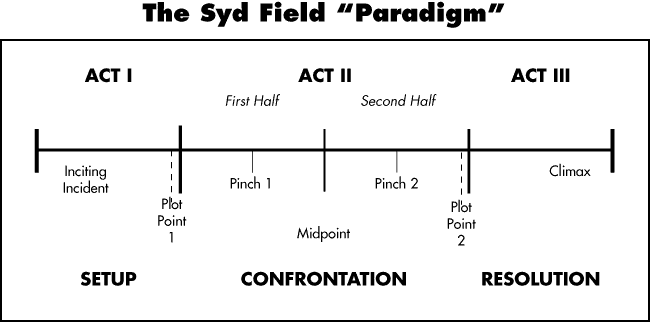
2. Paradigm of a screenplay.


Screen writing is  a craft, a craft that can be learned. It  is a definite craft, a definite art.

steve spielberg quote

3 act structure
Structure is like gravity:  It is the glue that holds the story in
place; it is the base, the foundation, the spine, the skeleton of the story. And it is this relationship between the parts and the whole that holds the screenplay together. It's what makes it what it is. It is the paradigm of dramatic structure.
A paradigm is a model, example, or conceptual scheme. This is the paradigm of a screenplay.


If a screenplay is a story told with pictures, A beginning, middle, and end, though not necessarily, as mentioned, in that order; it is a story told in pictures, in dialogue and description, and placed within the context of dramatic structure.


Aristotle talked about the three unities of dramatic action: time, place, and action. The normal Hollywood film is approximately two hours long, or 120minutes; This is a standard length, That's approximately 128 pages of screenplay. One page of screen play is approximately one minute of screen time. A page of screenplay equals a minute of screen time. It's a good rule of thumb to follow.

ACT I IS THE SET-UP
Act I, the beginning, is a unit of dramatic action that is approximately twenty or thirty pages long and is held together with the dramatic context known as the Set-Up.


Context is the space that holds something in place—in this case, the content. The context is what holds the content in place. 


In this unit of dramatic action, Act I, the screenwriter sets up the story, establishes character, launches the dramatic premise (what the story is about), illustrates the situation (the circumstances surrounding the action), and creates the relationships between the main character and the other characters who inhabit the landscape of his or her world.


As a writer you've only got about ten minutes to

establish this, because the audience members can usually determine, either consciously or unconsciously, 
ACT II IS CONFRONTATION

Act II is a unit of dramatic action approximately sixty pages
long, and goes from the end of Act I, anywhere from pages20 to 30,to the end of Act II, approximately pages 85 to 90, and is held together with the dramatic context known as Confrontation.
 During this second act the main character encounters obstacle after obstacle that keeps him/her from achieving his/her dramatic need,which is defined as what the character wants to win, gain, get, or achieve during the course of the screenplay


All drama is conflict. Without conflict, you have no action; without action, you have no character; without character, you have no story; and without story, you have no screenplay.


ACT III IS RESOLUTION

Act III is a unit of dramatic action approximately twenty to thirty pages long and goes from the end of Act II, approximately pages 85 to 90, to the end of the screenplay. It is held together with the dramatic context known as Resolution. Resolution does not mean ending; resolution means solution. Act III is that unit of action that resolves the story. It is not the ending; the ending is that specific scene or shot or sequence that ends the script.


Beginning, middle, and end; Act I, Act II, Act III. Set-Up,
Confrontation, Resolution—these parts make up the whole.

 
 How do you get from Act I, the Set-Up, to Act II, the Confrontation?
Or
 And how do you get from Act II to Act III,
the Resolution?
 To create a Plot Point at the end of both Act I and Act II.


A Plot Point is defined as any incident, episode, or event that

hooks into the action and spins it around in another   direction. 


In this case, Plot Point I moves the action forward into Act II and Plot Point II moves the action into Act III. Plot Point I occurs at the end of Act I, anywhere from pages 20 to 25 or 30.

A Plot Point is always a function of the main character.

Plot Points serve an essential purpose in the screenplay; they are a major story progression and keep the story line anchored in place. Plot Points do not have to be big, dynamic scenes or sequences; they can be quiet scenes in which a decision is made,


Plot Point II is really the same as Plot Point I; it is the way to
move the story forward, from Act II to Act III. It is a story progression. As mentioned, it usually occurs anywhere between pages 80 or 90 of the screenplay.

What's the distinction between form and formula?
The paradigm is a form, not a formula. Structure is what holds the story together. It is the spine, the skeleton. Story determines structure; structure doesn't determine story.


The form remains intact.  A formula, however, is totally different.  A formula never varies; certain elements are put together so they come out exactly the same each and every time. A screenplay, on the other hand, is unique, a totally individual presentation.


The dramatic structure of the screenplay maybe defined as a linear arrangement of related incidents, episodes, or events leading to a dramatic resolution.


The paradigm is a model, an example, or a conceptual scheme; it is what a well-structured screenplay looks like, an overview of the story line as it unfolds from beginning to end.
Screenplays that work follow the paradigm. But don't take my word for it. Go to a movie and see whether you can determine its structure for yourself.
told with pictures.


You should also read as many screenplays as possible in order to expand your awareness of the form and structure.

The paradigm works. It is the foundation of every good screenplay, the foundation of dramatic structure.


Source:

Screenplay: The Foundations of Screenwriting: Syd Field ..

 syd field


Media Effects

Media control

Media freedom is seen as central to the construction of democratic societies.  Media  is inevitably influenced by internal factors and external constraints.


Internal factors

 journalists’ social backgrounds can influence what and how the media reports.

External constraints

These include economic, political and legal considerations. For example:

  • Economic: The libertarian/consumer choice model exaggerates the power of the consumer and ignores the influence of the media owners and advertisers. Power is increasingly concentrated in the hands of a few global players due to convergence and globalization. The media become the suppliers of audiences for advertisers rather than public service.

  • Political: The role of the media as a source of political and ideological influence is widely recognised.  Authoritarian government Media is used to maintain social order  and liberal governments use it to present information in particular ways  in order to influence public perceptions.

  • Regulation: most state control is exerted through laws (e.g. Official Secrets Act, Obscene Publications Act, and civil laws governing copyright, privacy, libel etc). There are also voluntary codes of conductregulated by bodies such as the Press Council of India and NBA.

Theoretical perspectives

Early perspectives feared the development of the mass society as a threat to the established order and education system(and elite rule) and to the standards of the established . Ultimately the dominant paradigm that emerged was a more positive one, although this has been subject to critique with the emergence of alternative paradigms, from feminist, critical theoretical and Marxist positions.


The dominant paradigm

The dominant paradigm perceived society as liberal, democratic and orderly and viewed the mass media as contributing to that.

  • Functionalists believed mass media was central to the socialisation, integration and maintenance of social consensus, and
  • pluralists emphasised its role in liberating individuals and communities by providing information and opening opportunities to stimulate debates and share beliefs within a heterogeneous popular culture.


Alternative paradigms

There are a number of approaches which challenge the (perceived) conservatism of the dominant paradigm within which understandings of the mass media have evolved. For example:


  • Marxist perspectives (e.g. Adorno, Althusser) invariably argue that the media produces a false and one-dimensional consciousness among the working-classes. Also Media suppressing their revolutionary potential and perpetuating the world-view of a powerful elite. More liberal Marxists recognise that there are spaces of resistance and the potential for sub-cultural practices to develop.

  • The Glasgow Media Group highlight persistent bias in media content and imbalances in reporting 

  • Postmodernist Mark Postman (1987) proposes that the constant quest for amusement/entertainment is replacing more demanding forms of engagement (such as reading) and sees this pattern as a threat to political and cultural forms.

  • Feminists highlight the ways in which the mass media represented women from a male perspective (as a objects, as housewives and more recently have shown how this has changed in response to the feminist critique and women’s changing social roles.

The power of the media

There is more opinion than evidence to show the media’s potential to influence attitudes and behaviour, whether that is in an economic, political, moral or social sense. For example,

  • Economic influence: Vast amounts are spent on advertising by companies believing that the media can influence consumer choice.

  • Political influence: In some societies access to broadcasting during election times is controlled. There have been some quite memorable media campaigns by political parties, although research suggests media campaigns do little more than reinforce existing attitudes.  The media has the potential to set the agenda for political discussion e.g. by emphasising a particular aspect of policy and may thus persuade uncommitted voters.

  • Moral and social influences: Since the 1990s forms of screen violence (of cartoons, video games, films and online content) was linked to a perceived increase in children’s violence and in young people’s attitudes (e.g. extreme pornography impacting on their attitudes towards women). 

Media effects

There are a number of different models of media effects, some of which are shown below. It is important to remember that these are not mutually exclusive, but represent different perspectives that may be applied to the study of media effects.

  • Early ideas tended to emphasise the power of the media to change attitudes and behaviour (the hypodermic syringe model) whereas the subsequent response argued at the other extreme for a no effects model.

  • The long term effects model draws attention to how different cultural communities interpret media creations, and to the role of the media in reinforcing (negative) attitudes towards particular groups.

  • This latter point illustrates the role of the media in creating moral panics (i.e. another effect). Research in this aspect of media effects shows how the media can focus on particular phenomena (e.g. teen knife crime) presenting an exaggerated view and sensitising the audience to the issue.

  • A final area of media affects research focuses on ‘the active audience’ which returns to the issue of how audiences use and interpret the media and by using ethnographic methods reveals the diverse and fragmented ways in which people do make sense of what they see or hear in the media.