Socrates

"The only true wisdom is in knowing you know nothing." 

Socrates

"To find yourself, think for yourself."

Nelson Mandela

"Education is the most powerful weapon which you can use to change the world."

Jim Rohn

"Success is nothing more than a few simple disciplines, practiced every day." 

Buddha

"The mind is everything. What you think, you become." 

Monday, 28 February 2022

Elements of a Short Story


STORY

A story is basically a narrating of real or imaginary events, involving real or imaginary peopleA short story is a short work of fiction. Fiction, as you know, is prose writing about imagined events and characters. Prose writing differs from poetry in that it does not depend on verses, meters or rhymes for its organization and presentation. A story is generally designed to entertain, and/or send a message across.

The length of a written story will depend on the format, whether it is a novel, novella, short story etc. The length of a story has no bearing to its quality. 

Structure/Format of a Story

 There is a basic structure one can follow. It helps construct a story in an understandable manner and keeps the flow of the story.

Beginning: The beginning or the introduction of a story is of essential importance. This is the part where you can hook the reader and capture their attention. You must have come across some often-used beginnings to stories like, “Once upon a time” or “A long time ago”. However, you can get more creative and begin your story with intrigue.

Character Introduction: Your story will depend heavily on how well you introduce  your characters. To develop your characters, you can use dialogues as well. Also, do not include unnecessary secondary characters. Every character of the story must have a purpose.

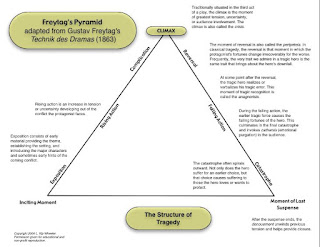
Plot: A plot is a series of events and character actions that relate to the central conflict.Here is where the actual narration of the story will happen. The events that occur or the description of the situation will be written in the plot. A plot must always have a conflict, which is the focus of any story.


Plot and Structure

The plot is the main sequence of events that make up the story. In short stories the plot is usually centered around one experience or significant moment. Consider the following questions:

  • What is the most important event?
  • How is the plot structured? Is it linear, chronological or does it move around?
  • Is the plot believable?

Climax/Conclusion: And this is where the story will come to its logical conclusion. If there is a plot twist, this is where you will include it. Always end your story in an interesting manner. Also, it is not necessary to give your story a definite ending.


American literature contains some of the world's best examples of the short story. Readers around the world enjoy the finely crafted stories of American writers such as O. Henry, Stephen Crane, Jack London, Mark Twain and Edgar Allen Poe.


What makes these authors such remarkable short story writers? They are true masters at combining the five key elements that go into every great short story: character, setting, conflict, plot and theme.

A character is a person, or sometimes even an animal, who takes part in the action of a short story or other literary work.

Characterization

Characterization deals with how the characters in the story are described. In short stories there are usually fewer characters compared to a novel. They usually focus on one central character or protagonist. Ask yourself the following:

  • Who is the main character?
  • Who or what is the antagonist?
  • Are the main character and other characters described through dialogue – by the way they speak (dialect or slang for instance)?
  • Has the author described the characters by physical appearance, thoughts and feelings, and interaction (the way they act towards others)?
  • Are they static characters who do not change?
  • Are they dynamic characters who change?
  • What type of characters are they? What qualities stand out? Are they stereotypes?
  • Are the characters believable?
  • Do the characters symbolize something?


Setting

Setting is a description of where and when the story takes place. . Authors often use descriptions of landscape, scenery, buildings, seasons or weather to provide a strong sense of setting.In a short story there are fewer settings compared to a novel. The time is more limited. Ask yourself the following questions:

  • How is the setting created? Consider geography, weather, time of day, social conditions, etc.
  • What role does setting play in the story? Is it an important part of the plot or theme? Or is it just a backdrop against which the action takes place?
  • Does the setting change? If so, how?
  • Study the time period, which is also part of the setting, and ask yourself the following:

    • When was the story written?
    • Does it take place in the present, the past, or the future?
    • How does the time period affect the language, atmosphere or social circumstances of the short stor


CONFLICT:  Conflict or tension is usually the heart of the short story and is related to the main character. In a short story there is usually one main struggle.The conflict is a struggle between two people or things in a short story. The main character is usually on one side of the central conflict.

On the other side, the main character may struggle against another important character, against the forces of nature, against society, or even against something inside himself or herself (feelings, emotions, illness).

  • How would you describe the main conflict?
  • Is it an internal conflict within the character?
  • Is it an external conflict caused by the surroundings or environment the main character finds himself/herself in?

CLIMAX:  The climax is the point of greatest tension or intensity in the short story. It can also be the point where events take a major turn as the story races towards its conclusion.

RESOLUTION:  The resolution is the end of the story. It focuses on how the conflict is ultimately resolved.

  • Are the closing sentences significant? How does the end relate or connect to the opening?

Narrator and Point of View

The narrator is the person telling the story.  Consider this question: Are the narrator and the main character the same?

By point of view we mean from whose eyes the story is being told. Short stories tend to be told through one character’s point of view. The following are important questions to consider:

  • Who is the narrator or speaker in the story?
  • Does the author speak through the main character?
  • Is the story written in the first person “I” point of view?
  • Is the story written in a detached third person “he/she” point of view?
  • Is there an “all-knowing” third person who can reveal what all the characters are thinking and doing at all times and in all places?
  • Is the narrator trustworthy?

Theme

The theme is built on a topic, such as death, hope, the American dream, etc. and how the topic affects the human condition, society, or life.  As a reader, focus on what the story is revealing about the topic.  The theme should be expressed as a statement, a general observation about human nature.The theme is the central idea or belief in a short story.

What a theme is NOT:

  • a word or phrase (topic or subject)
  • a command
  • a judgment

To help you construct the thematic statement, make a list of important images, topics, etc. found in the text.  Try to create a statement that includes the words in your list.


NOVELS

Novels are another example of fictional prose and are much longer than short stories.

NOVELLA

Some short stories, however, can be quite long. If a a short story is a long one, say fifty to one hundred pages, we call it a novella.


Work sheet

Source

Source

ernest-hemingway

Heming way style

hemingway tips

old-man-and-the-sea


Sunday, 27 February 2022

MEDIA WRITING SKILLS AND CHARACTERISTICS


KNOWLEDGE OF AP STYLE

Most media outlets use AP style—the style established and constantly updated by the Associated Press—as the foundation for basic news and media writing. AP style provides consistency in writing across media outlets and publications. The stylebook is available both online and in hard copy. In general, AP style has evolved to ensure that media writing is accurate, impartial, and clear to the audience.https://www.apstylebook.com/

KNOWLEDGE OF GRAMMAR AND PUNCTUATION

Media professionals need to hold  a high standard when it comes to knowledge of grammar and punctuation. here are a few basic grammar and punctuation rules:


Use simple sentences that follow the subject, verb, object order (example: Rama killed Ravana).
  • Use active, not passive voice. Active voice helps with clarity and concise writing. Understand word choice and meaning:
    • affect, effect
    • its, it’s
    • they’re, their, there
    • accept, except
    • நிலா, விலா,விழா,
    • கலை, களை,
    • பயன்பாடு,பயண்பாடு
    • குலம், குளம்,
    • பழம்,பலம்,
    • மலை,மழை,
  • Be aware of comma uses:
    1. Set off modifiers and Separate an introductory phrase or word, Before a conjunction, When writing a series of items (three or more).

ABILITY TO SIMPLIFY INFORMATION

As a media professional, you will need to synthesize and make sense of a great deal of information for our audience, often under a strict deadline. It is very essential to have a good storytelling skill, and the ability to focus on the essential information.


FOCUS ON ACCURACY AND DETAILS

When we write for the media, we represent not only our personal brand but also the broader organization for which you are producing content.

Precise writing and transparency give newsrooms credibility; misinformation can severely diminish the integrity of the media outlet.

There are types of accuracy

  1. Document accuracy refers to the proper coverage of our topics in appropriate detail. Often an accurate document needs to focus clearly on a problem. These writing tools help us to focus our writing effort .
  2. Stylistic accuracy concerns the careful use of language to express meaning.

Ø  Accurate language requires the careful use of paragraph and sentence structure and word choice to describe and analyze our topics effectively.

Ø  As a writer, you gain command of accuracy by studying the elements of style and by learning to apply those elements to our drafting, revising, editing, and proofreading.

Ø  Stylistic accuracy is also a matter of using words precisely.

3.      Technical accuracy requires stylistic accuracy but is not based solely on it. Technical accuracy depends on the writer's conceptual mastery of the subject and its vocabulary, as well as on his or her ability to analyze and shape data with a minimum of distortion.

WRITING OBJECTIVELY


The word objective refers to facts that are provable or verifiable.   Objective writing is writing that you can verify through evidence and facts. writing objectively means remain as neutral as possible through the use of facts, statistics, and research. This type of writing is best for  a writer need to present unbiased information to an audience and then let them determine their own opinion.

Objectivity is one of the principles of journalism, according to the code of ethics of the Society of Professional Journalists. Media writing should provide well-rounded analyses and stories that include all major perspectives.


Being objective means a journalist must concerned about facts and are not influenced by personal feelings or biases.


Try to consider both sides of an argument and avoid making value judgements by using words such as wonderful or appalling.


Techniques for making your writing more objective

Be clear in expressing your ideas:

several    10, most of the population    70%, some time ago    three years ago; or in 2006

Avoid intensifiers which can tend to exaggerate writing in an inaccurate , subjective way:

  • For example, awfully, very, really.

Balanced in your work, professional and believable:

  • Try to avoid making value judgements through use of words such as amazing or dreadful.

First vs. third person

  • First person: I, we, me, us
  • Second person: you
  • Third person: he, she, it, they, him, her, them

It is appropriate to use the first person (e.g. reflective writing). However, for other assignments the third person is preferred. Sometimes a mixture of the first and third person should be used for different purposes.


CLARITY

Media professionals generally write for a large, mainstream audience. Clear and concise writing makes it easier for a wide variety of groups to understand the core message. Complex sentence structures and jargon writing are not appropriate for diverse populations. Use simple sentences to get your point across.Clarity in writing means the ease with which a reader can understand you. It means avoiding unintended ambiguity or confusing sentence structure. 

 Clarity in writing refers to writing’s ability to convey:

  • Coherent, intelligible meaning , readers can understand the writing and what the author is trying to say, to a reasonable degree)
  • Sharpness of image or idea 

AVOID SUBJECTIVE WRITING

A subjective point of view is something based on one’s opinions, perspectives, beliefs, discoveries, desires, and feelings. It has no concern with right or wrong, other than the person’s opinion of what is right and wrong. Likewise, subjective writing or point of view is based on the writer’s own observation and experience. It focuses on the writer’s personal point of view and not built on facts that others see or things others go through.

Third person point of view can also be subjective. It is known as “limited omniscience,” in which a writer knows every detail about a character and sees the whole story through that character’s eyes.

Examples of subjective sources of information

  • Personal letters
  • Diaries
  • Blogs
  • Social media posts

Difference between Subjective and Objective

The major difference between subjective and objective is that subjective information is based on just one person’s feelings, assumptions, and opinions. It has a viewpoint of that person regardless of information or arguments it offers. Objective, on the other hand, is the information a writer or speaker provides outside of his/her personal opinions or feelings. It is based on facts.


Monday, 6 December 2021

Sound!

It is crucially important to human experience and to sound design in film.

Sound is important in a film production. Different aspects of sound enhance the characters and the story, making the movie a complete experience. In addition, sound is edited into the movie so it is coherent and comprehensible within the movie.

Some sort of sound is always used to enhance the movie experience. Sound in a movie includes 

  1. music, 
  2. dialogue, 
  3. sound effects, 
  4. ambient noise, and/or background noise and 
  5. soundtracks

Music

 Music is a very important element for a movie. In the silent movie period, music was played throughout the whole movie. The film score is the music at the beginning of the movie when the credits are rolling, and it sets the atmosphere for the movie.

Music is also played at critical points during a movie. It indicate  something is going to happen,  some situations have occurred in  a movie, 

Dialogue

Dialogue is defined as a conversation between two or more people in a movie. In addition, a movie could have a monologue where a character is speaking out loud when he or she is alone. A character, for example, may contemplate the pros and cons of talking some form of action in a monologue.

A movie can also have voice-over narration. Voice-over narration is when a character is explaining what has transpired in a movie and why. 100 years ago, there were silent movies with no audio dialogue, but dialogue cards were used, and background music set the tone of the scene. Take a look at the following example of a scene with and without dialogue.

Sound Effects

It defines sound effect as “any sound, other than music or speech, artificially reproduced to create an effect in a dramatic presentation, as the sound of a storm or a creaking door.” An action movie, for instance, is more interesting and bolder with sound effects. With sound effects, the viewer gets more involved with the movie.

Sound effects are most often added into the movie post production.  player. Music and sound effects give an aspect of the character.

Ambient Noises (Background Noise)

Ambient noises are background noises that are in a room, a house, outside, or any given location.  Every location has distinct and subtle sounds created by its environment. Ambient noises are types of sound effects. Background noise gives the movie more realism.


Soundtracks

A soundtrack is an audio recording created or used in film production or post-production.  Initially, the dialogue, sound effects, and music in a film have their own separate tracks (dialogue track, sound effects track, and music track), and these are mixed together to make what is called the composite track, which is heard in the film.

Late in the 1940s “sound track” became one word, “soundtrack.”  A soundtrack or an original soundtrack from a movie became a way of advertising the movie.

THE LUMIÈRE BROTHERS

Famous for inventing the cinematograph and the autochrome, Auguste and Louis Lumière are among the most significant figures in film and photography history.

With their first Cinématographe show in the basement of the Grand Café in the boulevard des Capucines in Paris on 28 December 1895, the Lumière brothers have been regarded as the inventors of cinema—the projection of moving photographic pictures on a screen for a paying audience. However, they were probably not the first to do this: the Latham brothers in New York were screening boxing films to paying audiences from 20 May 1895, using their Eidoloscope projector.

Nevertheless, the achievement of the Lumière brothers was considerable. Their Cinématographe was the first satisfactory apparatus for taking and projecting films, and its claw mechanism became the basis for most cine cameras.

THE LUMIÈRE BROTHERS’ BEGINNINGS

Auguste and Louis Lumière were born in Lyon, France, where their father, Antoine Lumière, had a photographic business. At the age of 17, Louis invented a highly sensitive photographic plate which the Lumière family began manufacturing. It was so successful commercially that the Lumières built a factory in the Monplaisir suburb of Lyon. By 1894, they were employing 300 people.


Late that year, Antoine saw an example of Edison’s peepshow Kinetoscope in Paris and encouraged his sons to develop an apparatus that would take and project moving pictures. Within a few months, they produced a successful prototype of the Cinématographe, which was not only a camera but a printer and projector as well. It was patented in France on 13 February 1895.

THE CINÉMATOGRAPHE

Compared with other attempts at producing a movie camera,

1.       the Cinématographe was remarkably compact and, unlike the Edison Kinetograph, it did not rely on electrical power, which few premises had at that time.

2.      The Cinématographe could be taken anywhere, either to shoot film or to use as a projector—all that was required was a magic lantern lamphouse with a gas or limelight illuminate.

At the heart of the Cinématographe was the film transport mechanism, whereby two pins or ‘claws’ were inserted into sprocket holes at each side of the film, moved it down and were then retracted, leaving the film stationary for exposure. This    recurrent movement was designed by Louis and based on the principle of the sewing machine mechanism.

MAKING EARLY FILMS

The Lumière brothers’ first film  was shot outside their factory as the workers left at the end of the day. It was shown to the Société d’Encouragement à l’Industrie Nationale in Paris on 22 March 1895: this was probably the first public screening of moving pictures ,the Lathams’ first public demonstration in New York took place on 21 April 1895.

At the Paris meeting, Louis met the engineer Jules Carpentier, who undertook to refine and manufacture the Cinématographe for the Lumières.

Later that year, the Lumière brothers made a number of other films, all around a minute long, showing scenes such as


Auguste and his wife feeding their baby;

a train arriving at La Ciotât in the south of France;

and possibly the first film comedy, L’arroseur arrosé, in which a mischievous boy tricks a gardener into being soaked with water and is chased and spanked.

Another public demonstration of the Cinématographe was given to the French Photographic Congress held in Lyon in June 1895, when the delegates were particularly impressed at seeing film of themselves taken the previous day.


THE PUBLIC LAUNCH OF THE CINÉMATOGRAPHE

Against his sons’ wishes, Antoine Lumière decided to launch the Cinématographe publicly in Paris on 28 December 1895. The screening was organised by Antoine and Clément Maurice, with three members of the Lumière staff in charge of projection. The Lumière brothers and Carpentier were not there. The first show was given to an invited audience of journalists, theatre directors (including Georges Méliès) and friends. Thereafter, the public shows commenced.

Each show comprised ten films and lasted about 15 minutes. There were twenty shows a day, starting at 10.00 and ending at 01.30 the next morning, with breaks at 12.00–14.00 and 19.00–20.00. Admission was one franc.

There was little public interest at first—the few papers that reported on it criticised the name ‘Cinématographe’—but news soon spread. On some days, queues extended a quarter of a mile, and the takings amounted to 2,500 francs (more than £42,000 in today’s money).

THE CINÉMATOGRAPHE IN BRITAIN

The first public screening of the Cinématographe in Britain took place at the Malborough Hall of the Royal Polytechnic Institution in Regent Street, London on 21 February 1896. There had been a press show the previous day when, coincidentally, the British cinema pioneer Robert Paul had demonstrated his Theatrograph projector at Finsbury Technical College

The opening performance attracted only 54 customers but, as in Paris, the Cinématographe’s popularity soon increased. Cinema quickly became part of music hall programmes.

Lumière Cinématographe, c.1986 © Science Museum Group Collection

THE CINÉMATOGRAPHE GOES GLOBAL

In the first years of the Lumière film operation, cameramen were sent all over the world to record scenes in locations such as Russia, Japan and the Holy Land.

In America, the first Cinématographe show took place at eith’s Union Square Theater, New York on 29 June 1896.

In November the Lumière brothers established their own agency in New York, selling equipment and films. This was very successful for a few months, but the Lumière brothers had fallen foul of the American customs by importing apparatus and films illegally—their manager had to escape the country—but mainly because films sprocketed in the Edison format were becoming the industry standard.

The Lumière brothers began to issue copies of films in both their original and the Edison format, but the ubiquity of the latter signalled the obsolescence of the original Cinématographes. Before the end of 1897, the Cinématographe had largely been superseded by the Lumière Cinématographe Model B, a projection-only machine designed for film with Edison perforations.

THE LUMIÈRE BROTHERS MOVE AWAY FROM CINEMA

Auguste and Louis continued to work on technical developments, and in 1900 devised a camera which took large-format 75mm films. By 1905, however, the Lumière brothers withdrew from the cinema business. They worked instead on inventing the first successful photographic colour process—the Lumière Autochrome—in 1907. Louis also worked on a process of stereoscopic cinematography.

The two brothers lived long enough to be famous as pioneers of the cinema within their lifetimes.


Sunday, 5 December 2021

History of film from 1830-1910