Socrates

"The only true wisdom is in knowing you know nothing." 

Socrates

"To find yourself, think for yourself."

Nelson Mandela

"Education is the most powerful weapon which you can use to change the world."

Jim Rohn

"Success is nothing more than a few simple disciplines, practiced every day." 

Buddha

"The mind is everything. What you think, you become." 

Wednesday, 29 January 2020

Rasa – Indian Aesthetic Theory


Rasa is a central concept in Indian aesthetic theory. The term has a variety of meanings Aesthetics refers to a distinctive type of emotional experience that can be experienced in connection with an artwork. The concept is presented in the Nāṭyaśāstra (200-500 C.E.), traditionally attributed to Bharata, a work that amounts to a collection of knowledge on dramatic performance (including music and dancing).
That Nāṭyaśāstra enumerates eight rasas that can be aroused in audience members through skillful performances.
These include
1.     the erotic (śṛṅgāra), 
2.     the comic (hāsya),
3.     the pathetic or sorrowful (karuṇa),
4.     the furious (raudra), the heroic (vīra),
5.     the terrible (bhayānaka),
6.     the odious (bībhatsa), (hateful)and
7.     the marvelous (adbhuta). 
8.     Later interpreters often acknowledged a ninth rasa,
9.     the tranquil (śānta).
Each rasa corresponds to a bhava, an ordinary emotion that is presented in the drama. 
Rasa, however, is a distinctively aesthetic kind experience in which one savors the essence of an emotion type. It is considered to be an achievement, both on the part of performers who are able to bring out the universal dimensions of emotion presented in a play and on that of the audience member who is sufficiently cultivated to appreciate such universalized emotion.
Rasa can be attained only by the person who is detached from personal motives and interests and identifies with the supreme universal Self. 
Abhinava also emphasizes the ninth rasa, the tranquil (śāntarasa), which he sees as the goal of all the other rasas
He compares the experience of this rasa to that of spiritual liberation (moka), which is the goal of every human life.

Emotional states and Rasa 5 The permanent emotional states alone are said to obtain the status of the Rasa. 
They are eight in number of which
 four are primary and 
four are secondary. 
The primary Rasa produces the respective secondary Rasa in the following manner: 1. Erotic (Shringar) to Comic (Hasya); 2. Heroic (Veer) to Marvellous (Adbhut); 3. Furious (Roudra) to Pathetic (Karun); 4. Odious (Bibhatsa) to terrible (Bhayanak); The erotic, comic, heroic, and marvelous are positive traits of mind, however the furious, pathetic, odious, and terrible are negative. The Erotic (Shringar)
 Rasa is derived from the dominant state of love and has its basis in shining and brighter aspects of the world such as white, pure, and beautiful. 
The Comic (Hasya) Rasa has its basis in the dominant emotion of laughter. It is derived from showing unseemly dress or ornament, impudence, greediness, quarrel or defective limb. 
The Heroic (Veer) Rasa has its basis in the superior type of persons, grandeur, greatness, goodness, strength and energy. It displays concentration of mind, perseverance, diplomacy, discipline, military strength, aggressiveness, reputation of might, and frightening capacity etc. 
The Marvellous (Adbhut) Rasa finds its basis in the dominant state of astonishment. It is derived from the determinants such as sight of heavenly being or events, attainment of desired object, entrance into superior mansion, temple, audience hall, seeing illusory and magical acts etc.
 The Furious (Roudra) Rasa finds its basis in the dominant state of anger. It is derived from the determinant such as anger, rape, abuse, insult, untruth, allegation, jealousy and the like. The Rakshasas, Danavas, and haughty men are its sources.
 6 The Pathetic (Karun) Rasa is rooted in the dominant state of sorrow, misery, and suffering. It is derived from determinants such as afflictions due to separation from dear ones, divorce, loss of wealth, person, death, accident or plight and captivity. 
The Odious (Bibhatsa) Rasa has the dominant state of disgust. It is derived from determinants such as hearing of unpleasant, offensive, impure, harmful things or seeing and discussing them. On the stage it can be represented by consequents such as stopping the movement of all limbs, narrowing down the mouth and the like. 
The Terrible (Bhayanak) Rasa is rooted in the dominant state of fear. It is derived from the determinants such as hideous noise, sight of ghost, panic, anxiety, or voices of jackals and owls, an empty house, dense forest, sight of murder or death of hearing and discussion of such events and also horripilation, change of color and loss of voice etc. The wise should know that the Vibhav and the Anubhav are such matters in the art of acting as are actually created by human nature, and as closely follow the ways of human nature and worldly conduct” (Ibid:10). ‘Lokatraya’ has been the core content of the art. The human nature and conduct of the world being the guiding principle

Nishpatti According to Bharata, “Nishpatti is a manifestation (Abhivyakti) of what was already latent.” Abhinav says, “All Rasas are dominated by pleasure, because of being the manifest and uninterrupted form of tasting ones own consciousness” (Ghosh M.M. 1950:8) Debate over Shantih: Is it a Rasa? Abhinav Gupta considers Shantih (peace) as the ninth Rasa. This is the point of debate over its status of Rasa in the tradition of Sanskrit scholarship in art and literature. The debate provides new directions and insights in exploring the nature of man and the nature of art from the point of view of dramatic performance and aesthetic realization of both entertainment and instruction for proper education and culture. 

Monday, 20 January 2020

Michelangelo, his Paintings, and Sculptures

Michelangelo was one of the most inspirational and talented artists in modern history. Michelangelo was born on March 6, 1475 in Caprese near Arezzo, Tuscany Italy.

At age of 6, Michelangelo was sent to a Florence grammar school but he showed no interest in schooling. His father realized he had no interest in family's financial business and agreed to send him, to the painter Ghirlandaio to be trained as an apprentice at the age of 13. Michelangelo learned the technique of Fresco and draftsmanship (. a person who draws plans and sketches)

 He was the first artist who was recognized during his life time. He is also the first western artist whose biography was published when he is still alive. Two biographies for him was written, one was by Giorgio Vasari, who praised Michelangelo as the greatest artist since the beginning of renaissance. He is the best documented artist in 16th Century and has influenced so many areas of art development in the West. Together with Leonardo Da Vinci, the two stood out as strong and mighty-personalities with two  opposed attitudes to art, yet with a bond of deep understanding between them.

During his life, the western world underwent the Renaissance, which  changes in all aspects of life and culture, with dramatic reforms sweeping through the worlds of religion, politics, and scientific belief. 

Michelangelo was one of the most fervent(having or displaying a passionate intensity.) advocates of this exciting new philosophy, working with a remarkable energy that was mirrored by contemporary society. 

One of  the Italian Renaissance, his extraordinary talents emerged in early works such as the Pieta for the Vatican,  .and the statue of David commissioned for the city of Florence. 

(One of Michelangelo’s masterpieces, the most poetic and marvellous sculpture ever created.Michelangelo arrived in Rome in 1496 when he was 21 years old .   It was while in Rome, that Michelangelo sculpted Pieta, now in St. Peters in the Vatican, in which the Virgin Mary weeps over the body of Jesus. Michelangelo went to the marble quarry and selected the marble for this exquisite piece himself. It was frequently said that Michelangelo could visualise the finished sculpture just be gazing at a block of stone.


WHEN AND WHEN MICHELANGELO’S PIETA’ WAS CREATED


Michelangelo’s Pietà is the first sculpture created in Rome by Michelangelo, who at that time was in his early 20s (1497-1499) and was rather famous.
It’s one of the great masterpieces created by Michelangelo  and is also the only work where his signature is visible, carved on the sash running across Mary’s chest.

2. WHO COMMISSIONED MICHELANGELO TO CARVE THE PIETA’
Cardinal  Jean de Bilhères, who served as French ambassador of Charles VIII to the Papal States, commissioned Michelangelo to create the Pietà, a work that had to be his funeral monument and had to be placed in the Chapel of Santa Petronilla in Saint Peter’s Basilica. However, when the sculpture was displayed to the public, everybody stared at it in fascination and admiration, so in 1517 it was decided to place it in the sacristy of St. Peter’s Basilica.

3. MICHELANGELO’S PIETA’: STYLE
The agreement between Michelangelo and his client to make the Pietà, was signed on August 27th 1498, and contains the description of the subject.
Michelangelo didn’t limit himself to create the Pietà following the classical model, which established Mary’s vertical bust and Jesus’ horizontal body, but he modernized a traditional composition and gave the work a natural appearance never seen before.

4. MICHELANGELO’S PIETA’: DESCRIPTION
Mary is represented by Michelangelo as a young woman, sat on a rock symbolizing the Calvary (or the Golgotha), the mount where Jesus was crucified.
Jesus, instead, lays down on his mother’s legs, dead.
A lot has been written about Mary’s face, too young according to some critics, but Michelangelo probably wanted to allude to Virgin Mary’s beauty, which is more spiritual than physical.

5. MICHELANGELO’S PIETA’: FORTUNES AND EVENTS
Since its creation, Michelangelo’s Pietà has been considered a masterpiece.
In 1964 Michelangelo’s Pietà was loaned to the 1964–1965 New York World’s Fair and visitors waited in queue for hours to admire the sculpture!

He was now a man at the height of his creative powers, and, in 1504, back in  Florence, he completed his most famous sculpture, David. David, depicted at the moment he decides to battle Goliath, was a symbol of Florentine freedom. It is said to be a masterpiece of line and form. A committee, including Leonardo da Vinci and Sandro Botticelli, was created and decided on its placement, in front of the Palazzo Vecchio.

Michelangelo’s David stands nearly 17 feet tall.  Remember that the biblical figure of David was special to the citizens of Florence—he symbolized the liberty and freedom of their republican ideals, which were threatened at various points in the fifteenth century by the Medici family and others. Watch a video about the importance of the figure of David for Florence.David of Angelo

His paintings and frescoes(a painting done rapidly in water colour on wet plaster on a wall or ceiling, so that the colours penetrate the plaster and become fixed as it dries.) were largely taken from mythological and classical sources works. He manage to combine his high level of technical competence and his rich artistic imagination to produce the perfect High-Renaissance blend of aesthetic harmony and anatomical accuracy in his works.
This grand fresco contains over three hundred figures over five hundred square meters of ceiling. It took Michelangelo four years, lying on his back, to complete this masterful work, which stands even today as a testament to this one man's dedicated and accomplished artistry. The scenes depicted are from the Book of Genesis, the most famous of which is The Creation of Adam. The outstretched hands of God and Adam are an iconic image, perhaps the most widely known and imitated detail from any renaissance piece. Michelangelo, in this work, demonstrated his deep understanding of the human form, and how to depict it in a huge array of different poses.

Michelangelo became, during this time, an expert in portraying the human form, drawing from life and studying anatomy. He also obtained special permission from the Catholic Church to study human corpses to learn anatomy, though exposure to corpses had worsened his health condition
Michelangelo accepted many commissions, sculptures and paintings during his time in Florence, many of which went unfinished when, in 1505, he was called back to Rome to work on a Tomb for Pope Julius II. It was planned to be finished within 5 years but he worked on it (with frequent interruptions) for over forty years, and it seems it was never finished to his satisfaction. Fortunately, Michelangelo also completed some of his best, and most well-known work, during this time, most notably the fresco on the ceiling of the Sistine Chapel, which took him four years to finish.

Michelangelo's art has far reaching historic influence. His world is genetically a two-fold system continually expanding. Measuring his internal development from the Pieta through David to The Last Judgement, we view the path of an experience in which each stage provides the foundation for the next, from sculpture to painting, painting to architecture, architecture to the art of poetry.

In western world, he was the first - Picasso the last - to regard himself as an absolute and mythic cultural experience. He managed to combine his high level of technical competence and his rich artistic imagination to produce the perfect High Renaissance blend of aesthetic harmony and anatomical accuracy in his work.

Just like William Shakespeare on literature, and Sigmund Freud on psychology, Michelangelo's impact on art is tremendousMichelangelo not only outshines all his predecessors; he remains the only great sculptor of the Renaissance at its best. What most Late Renaissance artists lacked was not talent but the ability to use their own eyes and share a vision with either their contemporaries or posterity. Michelangelo's extreme genius left little scope for works that escaped his influence, damning all his contemporaries to settle for aping him. Appreciation of Michelangelo's artistic mastery has endured for centuries, and his name has become synonymous with the best of the Renaissance Art.


Friday, 10 January 2020

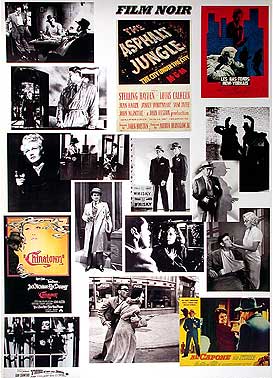
Film Noir

Film Noir (literally 'black film or cinema') was coined by French film critics (first by Nino Frank in 1946) who noticed the trend of how 'dark', downbeat and black the looks and themes were of many American crime and detective films released in France to theatres following the war, such as  The Maltese Falcon (1941)Murder, My Sweet (1944) Double Indemnity (1944)The Woman in the Window (1944), and Laura (1944). A wide range of films reflected the resultant tensions and insecurities of the time period, and counter-balanced the optimism of Hollywood's musicals and comedies. Fear, mistrust, bleakness, loss of innocence, despair and paranoia are readily evident in noir, reflecting the 'chilly' Cold War period when the threat of nuclear annihilation was ever-present. The criminal, violent, misogynistic, hard-boiled, or greedy perspectives of anti-heroes in film noir were a metaphoric symptom of society's evils, with a strong undercurrent of moral conflict, purposelessness and sense of injustice. There were rarely happy or optimistic endings in noirs.
Classic film noir developed during and after World War II, taking advantage of the post-war ambience of anxiety, pessimism, and suspicion. It was a style of black and white American films that first evolved in the 1940s, became prominent in the post-war era, and lasted in a classic "Golden Age" period until about 1960 (marked by the 'last' film of the classic film noir era, Orson Welles'  Touch of Evil (1958)).
Important Note: Strictly speaking, film noir is not a genre, but rather the mood, style, point-of-view, or tone of a film. It is also helpful to realize that 'film noir' usually refers to a distinct historical period of film history - the decade of film-making after World War II, similar to the German Expressionism or the French New Wave periods. However, it was labeled as such only after the classic period - early noir film-makers didn't even use the film designation (as they would the labels "western" or "musical"), and were not conscious that their films would be labeled noirs.
Very often, a film noir story was developed around a cynical, hard-hearted, disillusioned male character [e.g., Robert Mitchum, Fred MacMurray, or Humphrey Bogart] who encountered a beautiful but promiscuous, amoral, double-dealing and seductive femme fatale [e.g., Mary Astor, Veronica Lake, Jane Greer, Barbara Stanwyck, or Lana Turner]. She would use her feminine wiles and come-hither sexuality to manipulate him into becoming the fall guy - often following a murder. After a betrayal or double-cross, she was frequently destroyed as well, often at the cost of the hero's life. As women during the war period were given new-found independence and better job-earning power in the homeland during the war, they would suffer -- on the screen -- in these films of the 40s.
See this site's special tribute to
Greatest Femmes Fatales in Classic Film Noir
Titles of many film noirs often reflected the nature or tone of the style and content itself: Dark Passage (1947)The Naked City (1948)Fear in the Night (1947) Out of the Past (1947)Kiss Me Deadly (1955), etc.
Primary Characteristics and Conventions of Film Noir: Themes and Styles
The primary moods of classic film noir were melancholy, alienation, bleakness, disillusionment, disenchantment, pessimism, ambiguity, moral corruption, evil, guilt, desperation and paranoia.
Heroes (or anti-heroes), corrupt characters and villains included down-and-out, conflicted hard-boiled detectives or private eyes, cops, gangsters, government agents, a lone wolf, socio-paths or killers, crooks, war veterans, politicians, petty criminals, murderers, or just plain Joes. These protagonists were often morally-ambiguous low-lifes from the dark and gloomy underworld of violent crime and corruption. Distinctively, they were cynical, tarnished, obsessive (sexual or otherwise), brooding, menacing, sinister, sardonic, disillusioned, frightened and insecure loners (usually men), struggling to survive - and in the end, ultimately losing.
Storylines were often elliptical, non-linear and twistingNarratives were frequently complex, maze-like and convoluted, and typically told with foreboding background music, flashbacks (or a series of flashbacks), witty, razor-sharp and acerbic dialogue, and/or reflective and confessional, first-person voice-over narration. Amnesia suffered by the protagonist was a common plot device, as was the downfall of an innocent Everyman who fell victim to temptation or was framed. Revelations regarding the hero were made to explain/justify the hero's own cynical perspective on life.
Film noir films (mostly shot in gloomy grays, blacks and whites) thematically showed the dark and inhumane side of human nature with cynicism and doomed love, and they emphasized the brutal, unhealthy, seamy, shadowy, dark and sadistic sides of the human experience. An oppressive atmosphere of menace, pessimism, anxiety, suspicion that anything can go wrong, dingy realism, futility, fatalism, defeat and entrapment were stylized characteristics of film noir. The protagonists in film noir were normally driven by their past or by human weakness to repeat former mistakes.
Film noir films were marked visually by expressionistic lighting, deep-focus or depth of field camera work, disorienting visual schemes, jarring editing or juxtaposition of elements, ominous shadows, skewed camera angles (usually vertical or diagonal rather than horizontal), circling cigarette smoke, existential sensibilities, and unbalanced or moody compositions. Settings were often interiors with low-key (or single-source) lighting, venetian-blinded windows and rooms, and dark, claustrophobic, gloomy appearances. Exteriors were often urban night scenes with deep shadows, wet asphalt, dark alleyways, rain-slicked or mean streets, flashing neon lights, and low key lighting. Story locations were often in murky and dark streets, dimly-lit and low-rent apartments and hotel rooms of big cities, or abandoned warehouses. [Often-times, war-time scarcities were the reason for the reduced budgets and shadowy, stark sets of B-pictures and film noirs.]
Some of the most prominent directors of film noir included Orson Welles, John Huston, Billy Wilder, Edgar Ulmer, Douglas Sirk, Robert Siodmak, Fritz Lang, Otto Preminger, Henry Hathaway and Howard Hawks.
The females in film noir were either of two types (or archetypes) - dutiful, reliable, trustworthy and loving women; or femmes fatales - mysterious, duplicitous, double-crossing, gorgeous, unloving, predatory, tough-sweet, unreliable, irresponsible, manipulative and desperate women. Usually, the male protagonist in film noir wished to elude his mysterious past, and had to choose what path to take (or have the fateful choice made for him).
Invariably, the choice would be an overly ambitious one, to follow the dangerous but desirable wishes of these dames. It would be to pursue the goadings of a traitorous, self-destructive femme fatale who would lead the struggling, disillusioned, and doomed hero into committing murder or some other crime of passion coupled with twisted love. When the major character was a detective or private eye, he would become embroiled and trapped in an increasingly-complex, convoluted case that would lead to fatalistic, suffocating evidences of corruption, irresistible love and death. The femme fatale, who had also transgressed societal norms with her independent and smart, menacing actions, would bring both of them to a downfall.
Cinematic Origins and Roots of Classic Film Noir:
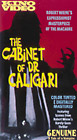
The Cabinet of Dr. Caligari - 1919The themes of noir, derived from sources in Europe, were imported to Hollywood by emigre film-makers. Noirs were rooted in German Expressionism of the 1920s and 1930s, such as in The Cabinet of Dr. Caligari (1920, Germ.)or Fritz Lang's M (1931, Germ.)Fury (1936) and You Only Live Once (1937). Films from German directors, such as F. W. Murnau, G. W. Pabst, and Robert Wiene, were noted for their stark camera angles and movements, chiaroscuro lighting and shadowy, high-contrast images - all elements of later film noir. In addition, the French sound films of the 30s, such as director Julien Duvivier's Pepe Le Moko (1937), contributed to noir's development.
Another cinematic origin of film noir was from the plots and themes often taken from adaptations of American literary works - usually from best-selling, hard-boiled, pulp novels and crime fiction by Raymond Chandler, James M. Cain, Dashiell Hammett, or Cornell Woolrich. As a result, the earliest film noirs were detective thrillers. Film noirwas also derived from the crime/gangster and detective/mystery sagas from the 1930s (i.e., Little Caesar (1930)Public Enemy (1931) and Scarface (1932)), but very different in tone and characterization. Notable film noir gangster films, such as They Drive By Night (1940)Key Largo (1948) and White Heat (1949) each featured noir elements within the traditional gangster framework.
The Earliest Film Noirs: In the 1940s
Many sources have claimed that director Boris Ingster's and RKO's Stranger on the Third Floor (1940) was the first full-featured film noir. The expressionistic film starred Peter Lorre as the sinister 'stranger' (cast due to his creepy performance in M (1931)), in a story about the nightmarish after-effects of circumstantial testimony during a murder trial. Others claim Orson Welles' masterpiece  Citizen Kane (1941) was also an early and influential pre-film noir.
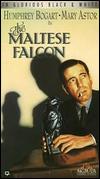
The Maltese Falcon - 1941The first detective film to use the shadowy, nihilistic noir style in a definitive way was the privotal work of novice director John Huston in the mystery classic  The Maltese Falcon (1941), from a 1929 book by Dashiell Hammett. [Actually, Huston's film was not the first version - it had been directed earlier by Roy Del Ruth in 1931, starring Ricardo Cortez in the lead role.] It was famous for Humphrey Bogart's cool, laconic private eye hero Sam Spade in pursuit of crooks greedy for a jewel-encrusted statue, and Bogart's foil - Mary Astor as the deceptive femme fatale.
Noir Duo: Alan Ladd and Veronica Lake
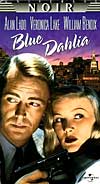
The Blue Dahlia - 1946The acting duo of Alan Ladd and Veronica Lake was first teamed in the superb early noir thriller This Gun For Hire (1942) (with the tagline: "He's dynamite with a gun or a girl"). From the novel A Gun For Sale by renowned British novelist Graham Greene, the moody noir featured Ladd in a star-making role (his first lead role) as a ruthless, cat-loving, vengeful, unsmiling San Francisco professional hit-man named Raven working for a peppermint-candy loving fat man Willard Gates (Laird Cregar) and his wheelchair-bound Nitro Chemicals executive Alvin Brewster (Tully Marshall) - both double-crossers who were selling secrets to foreign agents (the Japanese). Ladd was paired with popular wartime pinup star Lake as nightclub showgirl singer Ellen Graham, his hostage (and unbeknownst to him working as a federal agent).
Another Dashiell Hammett book of political corruption and murder was adapted for Stuart Heisler's The Glass Key (1942) for Paramount Studios - again with the duo of Ladd and Lake, and noted as one of the best Hammett adaptations. Ladd starred as Ed Beaumont, a right-hand man and political aide attempting to save his employer (Brian Donlevy) from a murder frame-up, while Lake played the seductive fiancee of the boss. The film was noted for the vicious beating given to Ladd by a crime lord thug (William Bendix).
The popular noir couple were brought together again in George Marshall's post-war crime thriller The Blue Dahlia (1946), with an Oscar-nominated screenplay by Raymond Chandler (the only work he ever wrote directly for the screen). Alan Ladd portrayed returning war veteran Johnny Morrison who discovered that his wife Helen (Doris Dowling) was unfaithful during his absence. When she turned up dead and he became the prime suspect, he was aided in the case by the mysterious Joyce Harwood (Lake) - the seductive ex-wife of his wife's former lover.

Orson Welles and Film Noir:
Orson Welles' films have significant noir features, such as in his expressionistically-filmed  Citizen Kane (1941), with subjective camera angles, dark shadowing and deep focus, and low-angled shots from talented cinematographer Gregg Toland. Welles' third film for RKO, the war-time mystery Journey Into Fear (1943), was one in which he acted and co-directed (uncredited) - it was set in the exotic locale of Istanbul. The film's story was inspired by Eric Ambler's spy thriller about the flight of an American arms engineer (Joseph Cotten) on a Black Sea tramp steamer where he was threatened by Nazi agents intent on killing him.
The complex The Lady from Shanghai (1948) - with its plot (from Sherwood King's novel If I Should Die Before I Wake), told about a destructive love triangle between Irish seaman Michael O'Hara (Welles himself), a manipulative Rita Hayworth as the platinum blonde-haired femme fatale Elsa (or Rosalie), and her husband Arthur Bannister (Everett Sloane). Its final sequence in a San Francisco "hall of mirrors" fun-house was symbolic and reflective of the shattered relationships between the characters, exemplified by a wounded O'Hara's last words: "Maybe I'll live so long that I'll forget her. Maybe I'll die trying."
Welles' Mexican border-town B-movie classic  Touch of Evil (1958) is generally considered the last film in the classic cycle of film noirs. It starred Charlton Heston as Vargas - a naive Mexican-American narcotics cop, Janet Leigh as his imperiled, honeymooning wife Susan, and Welles' own corrupt and corpulent local cop Hank Quinlan. The film also featured a comeback appearance by cigar-smoking bordello madam Marlene Dietrich, and a breathtaking opening credits sequence filmed in a single-take. Later, Welles' expressionistic noir and psychological drama The Trial (1962) was an adaptation of Franz Kafka's classic novel, with Anthony Perkins as Joseph K - a man condemned for an unnamed crime in an unknown country.
More Definitive 40s Noirs:
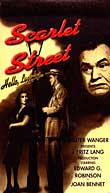
Scarlet Street - 1945Early classic non-detective film noirs included Fritz Lang's steamy and fatalistic Scarlet Street (1945) - one of the moodiest, blackest thrillers ever made, about a mild-mannered painter's (Edward G. Robinson) unpunished and unsuspected murder of an amoral femme fatale (Joan Bennett) after she had led him to commit embezzlement, impersonated him in order to sell his paintings, and had been deceitful and cruel to him - causing him in a fit of anger to murder her with an ice-pick. Director Abraham Polonsky's expressionistic, politically-subversive Force of Evil (1948) starred John Garfield as a corrupt mob attorney.

British director Carol Reed's tense tale of treachery set in post-war Vienna,  The Third Man (1949), with the memorable character of black market racketeer Harry Lime (Orson Welles), ended with a climactic shootout in the city's noirish underground sewer. And the nightmarishly-dark, rapid-paced and definitive D.O.A. (1949) from cinematographer-director Rudolph Mate - told the flashback story of lethally-poisoned and doomed protagonist Frank Bigelow (Edmond O'Brien), a victim of circumstance who announced in the opening: "I want to report a murder - mine." [It was remade as D.O.A. (1988) with Dennis Quaid and Meg Ryan.]


https://www.amazon.in/ref=as_li_ss_tl?ie=UTF8&ext_vrnc=hi&ascsub&ext_vrnc=hi&gclid=CjwKCAiA3uDwBRBFEiwA1VsajIdU1Lr5c4UMjyCyTfWedmyaDnoxkA9LpWjjom-1oQ3rOkuy4IsVZxoCIQ4QAvD_BwE&linkCode=ll2&tag=abel047-21&linkId=d62fa0b7a401db916cc93c12f5feadd9&language=en_IN

Sunday, 15 December 2019

Italian Renaissance -Leonardo da Vinci

The Italian Renaissance(ruh-nei-sawns)
 In painting, this unique approach was characterized by spiritual iconography, flat compositions, unrealistic color palettes, and ethereal, other worldly figures. 
In the 1300s, however, Italian artists based in Florence abandoned this distinctive aesthetic and adopted a more humanist approach to art. It would  be known as the Italian Renaissance.


Renaissance Art

The halfhearted or even ambiguous nature of this smile makes the iconic painting all the more enigmatic, prompting viewers to try to understand both the mood of its muse and the intention of its artist..

What are the “perfect” proportions?
  • four fingers equal one palm
  • four palms equal one foot
  • six palms make one cubit
  • four cubits equal a man’s height
  • four cubits equal one pace
  • 24 palms equal one man


The Italian Renaissance occurred between the 14th and 17 centuries in Italy. Derived from the word Rinascimento, or “rebirth,” the Renaissance is generally seen as an enlightened age of art.
During the Dark Ages (approximately 500-1000 AD), Italian art was predominantly rooted in religion.


 Italian Renaissance regarded as a golden age of art, music, and literature, the period has inspired creatives for centuries, with iconic works by master artists like Leonardo da Vinci and Michelangelo.

Leonardo da Vinci possessed a rare kind of cross-disciplinary genius. He was a  painter, engineer, architect, sculptor, scientist,inventor and futurist .


The Mona Lisa is an oil painting by Italian artist Leonardo da Vinci. The piece features a portrait of a seated woman set against an imaginary landscape.

The Mona Lisa  painted   from 1503, when he started it, to his deathbed in 1519.


Leonardo spent many pages in his notebook dissecting the human face to figure out every muscle and nerve that touched the lips. He was trying to get every aspect exactly right in layer after layer.  If you look directly at the Mona Lisa smile, the corners of the lips turn downward slightly, but shadows and light make it seem like it’s turning upwards. As you move your eyes across her face the smile flickers on and off.


 “Mona Lisa” is the culmination conclusion/finale) because the emotions that she’s expressing, just like her smile, are a bit elusive (subtle). Every time you look at her it seems slightly different. Unlike other portraits of the time, this is not just a flat, surface(superficial) depiction. It tries to depict the inner emotions. 

The figure sits with her arms folded as she gazes at the viewer and appears to softly smile—an aesthetic attribute that has proven particularly eye-catching over centuries. 

This figure of a woman, dressed in the Florentine fashion of her day and seated in a visionary, mountainous landscape, is a remarkable instance of Leonardo's sfumato technique of soft, heavily shaded modeling. The Mona Lisa's enigmatic expression, which seems both alluring and aloof, has given the portrait universal fame.

The portrait shows the subject sitting upright and sideways in a chair, with her face and chest turned slightly towards the viewer: a posture derived from the 'pyramid' image used to depict a sitting Madonna. Her left arm sits comfortably on the armrest of the chair and is clasped by the hand of her right arm which crosses her front. The slightly protective position of her arms, as well as the armrest, creates a sense of distance between sitter and spectator.

The background landscape behind the sitter was created using aerial perspective, with its smoky blues and no clearly defined vanishing point. It gives the composition significant depth, although its details reveal a clear imbalance between the (higher) rocky horizon to the right, compared to the (lower) flatlands stretching away on the left. This imbalance adds to the slightly surreal atmosphere of the picture.

The way Leonardo painted this portrait deviated from the traditional way women were painted like this in Italy.  Mona Lisa looks directly out at us, the viewers, which was something unconventional for a woman in a portrait to do at this time.  She also appears rather content and assured in her demeanor, which reflected more the expectations of the aristocracy among men rather than among women.  Further, until this point in time, portraits of both men and women were typically cut off in the middle of torso and hands were raised so that we the head and face and shoulders occupies more of the panel upon which the paint was applied.  Here, however, the portrait shows not only the woman’s head and upper torso, but much of her body down to just below her waist.  We see all of her arms, which are not raised up but resting comfortably on the armrests of her chair. 


The Duke of Milan asked him to paint it on the wall of a dining hall of a monastery. Leonardo doesn’t just capture a moment. He makes “The Last Supper” a dramatic narrative. As you walk in the door, you see Christ’s hand then, going up the arm, you stare at his face. He’s saying, “One of you shall betray me.” As your eyes move across the picture, you see that sound almost rippling outward as each of the groups of apostles reacts. Those nearest to him are already saying, “Is it me, Lord?” The ones further away have just started to hear it. As the drama ripples from the center to the edges, it seems to bounce back, as Christ reaches for the bread and wine, the beginning of what will be the institution of the Eucharist.

He liked to think of himself as an engineer and architect, which he also did with great passion. But his first job was as a theatrical producer.
From that he learned how to do tricks with perspective because the stage in a theatre recedes faster and looks deeper than it is. Even a table onstage would be tilted slightly so you can see it, which is also what we see in “The Last Supper.” Likewise, on the stage, the theatrical gestures of the characters would be exaggerated, which is what you also see in “The Last Supper.


The Vitruvian Man, a late 15th-century drawing, is a prime example of such work. 

Vitruvian From how the Vitruvian Man revolutionized the anatomical understanding of human proportions to Leonardo’s fascination with the brain to what his flying machine sketches taught the designers and engineers of the then-future presents a remarkable reminder of the cross-disciplinary curiosity and rigorous dedication that fueled one of humanity’s most prolific, profound and masterful creators.


Intended to explore the idea of proportion, the piece is part work of art and part mathematical diagram, conveying the Old Master‘s belief that “everything connects to everything else.”

The Vitruvian Man is based on De Architectura, a building guide written by Roman architect and engineer Vitruvius between 30 and 15 BC. While it is focused on architecture, the treatise also explores the human body—namely, the geometry of “perfect” proportions—which appealed to Leonardo’s interest in anatomy and inspired his drawing.

Leonardo da Vinci, who is interested in everything that could possibly be known about the universe, including how we fit into it. That made him a joyous character to write about.
In his notebooks, we see such questions as, describe the tongue of the woodpecker. Why do people yawn? Why is the sky blue? He is passionately curious about everyday phenomenon that most of us qu
it questioning once we get out of our wonder years and become a bit jaded.
Being curious about everything and curious just for curiosity’s sake, not simply because it’s useful, is the defining trait of Leonardo. It’s how he pushed himself and taught himself to be a genius. We’ll never emulate Einstein’s mathematical ability. But we can all try to learn from, and copy, Leonardo’s curiosity.


In the first, Leonardo notes that, according to Vitruvius, these are the measurements of the ideal body:
Additionally, the first set of notes also specifies: “If you open your legs so much as to decrease your height 1/14 and spread and raise your arms till your middle fingers touch the level of the top of your head you must know that the center of the outspread limbs will be in the navel and the space between the legs will be an equilateral triangle. The length of a man’s outspread arms is equal to his height.”